Tuesday, August 18, 2009

Bureaucrats


Among the many themes of dissent which have gained traction in the health care debate is the canard that we don't wont some government bureaucrat between us and our doctors. Funny thing about that: the only payer entity with which I never had a problem getting authorization for care was Medicare. Here's the sort betweenness I routinely encountered from private insurers:

In the fine print of nearly every private plan are exclusions for "pre-existing conditions." Okay. You had breast cancer, now you can't get any insurance to cover issues related to it. Fair enough, right? Guy's gotta make a buck, right? I mean, it wasn't their fault you got it, right?

But how about this: more than a couple of times I had patients with colon cancer who were denied coverage because of a previous history of.... hemorrhoids!! Yes. Hemorrhoids. Similarly, people who'd had, say, a rubber band placed for hemorrhoids -- a two minute, hundred buck outpatient procedure -- could not get future insurance that would cover ANY disease of the intestinal tract. Band on your butt, screw your stomach. Exit your esophagus. Not, I suppose, that a private insurer has to have any reason for something like that: their goal, after all, is to NOT spend your premiums on your care. Message: if you have hemorrhoids, live with them, baby.

There's more. Many patients of mine whose gallbladders I removed were informed by their insurers that they'd no longer be covered for any disease of their internal organs. A lot of territory excluded, that.

And, as everyone knows, if you lose your insurance because you lost your job, and if you've had any sort of serious illness, you are simply SOL finding new coverage. Imagine the frustration, as a physician trying to help, of dealing with insurance companies as they apply their exclusionary rules. Their rationing. Their death panels.

Yet there they are, those sign wavers, insisting that it's Hitleresque to demand changes in all this. For his attempts, Obama gets branded a Nazi. While the right wing screams, the left wing caves. Advance directives? Gone. Public option? Fuggeddaboutdit. Studies to find out which kinds care work and which don't? Nuh uh. Too... too... I don't know... logical?

I repeat: Medicare, which is in my mind the best paradigm for a public plan, NEVER refused coverage for cancer (or any) care. Not even for grandma. Those government bureaucrats? Not a problem. It was, as anyone might predict, the "market forces" guys who stood between me and my patients.

There is, of course, this little paradox: those people who hate government intervention generally are quite happy with Medicare. Those who point out it's running out of money are those most likely to recoil at suggestions that we ought to find ways of saving money in the program. The ones who think Medicare is shameful socialism would holler "they're trying to raise your taxes!!!" if anyone suggested premiums be scaled to one's financial status.

Is there a more clear example of why we're failing as a country than the debate over health care reform, and the arguments over Medicare in particular?

Wednesday, August 12, 2009

One Small Step


If anyone here reads Andrew Sullivan's blog, runs across this post, and finds anything familiar in the writing, there could be a reason... Anonymity doesn't do much for blog traffic, but any way to spread the word...

The word, of course, is the extent to which health care reform is aimed at doing things that will be helpful. Even -- especially! -- for those very people who yell and weep and carry guns to meetings, spouting verbatim the insane ravings of Glenn Beck and Sarah Palin while having not the slightest idea what they're really talking about. "Keep government out of Medicare," they say. "Socialism."

The "socialism" trope may be the most laughable (were it actually funny): all of the proposals on the table fall over themselves to maintain the death-grip insurance companies have on us. (Talk about "death panels!" What is it when insurers deny coverage?) None talks about nationalizing the health care delivery system. Not even Medicare is socialism. Single payer -- which in my mind is the only option that makes sense, and which, like Medicare is NOT socialism -- is, clearly, off the table.

There's no possible health care reform package that will satisfy everyone; nor, given the way Congress works, one that will be free of pork-fat, undue complexity, or unexpected consequences that will need to be addressed. Still, what the various iterations seem to have in common are regulations to prevent rescission, to create portability, to remove limits on lifetime coverage, to banish denial for pre-existing conditions. Is it really possible that any of the screamers are against those reforms?

Cost is most certainly an issue, and there is a multitude of ways to address it. Starting, from the doctors' part, with the sort of thing mentioned in that Andrew Sullivan post. Only the surface has been scratched there. And, long after I'm dead, assuming the country still exists, I predict single payer will have come to pass, and people will be glad for it. Even the gun-totin' America lovers.

Signs at the meetings -- ignoring the ones showing Obama as Hitler, a completely ludicrous meme hatched and promoted at Fox "News" (sic) and ingested without chewing by its self-pitying listeners -- point out that Medicare is "bankrupt." While not yet true, it's a point worth considering. To the extent that it hasn't enough money, it's not the fault of Medicare, which spends far less on non-medical expenses than any private insurer. It's because of funding. It's because of the holdover idea from the Reaganomics that you can have what you want without paying taxes.

So, what if everyone were covered by a Medicare-like program, and no one paid premiums; or if there were the sorts of premiums and co-pays associated with Medicare? Currently I pay $14K/year in premiums for me and my wife. Would I be happy to have taxes raised in another area, even, say, by $10K/year? Who wouldn't take that trade? By getting rid of the 30% skim by insurers, that math works right away. And by taking seriously -- instead of demagoging as "death panels" -- the idea of finding cost savings in more efficient care, much more than that will be saved.

And yet, they rave and froth. Getting crazier and scarier. Arguing, in effect, for maintaining a system in which their premiums have likely more than doubled in the last ten years, which covers them sparingly, cutting them off when they need it most: sick, out of work. And they are ready to draw weapons over a plan to pay for help writing the very instructions that will keep them in charge of their care when they're unable to make decisions for themselves.

Who'd have thought people so in need of health care reform could be whipped into a froth by people who lie so freely and make easily refutable claims? I remain unable to understand. And bereft of hope.

Tuesday, August 11, 2009

Local News


Using local anesthesia, I always took care to do it gently, slowly, and thoroughly, and had reason to be proud of the results. Almost routinely, patients expressed their happiness and relief that the process was so... not unpleasant. I've written a bit about it before.

So when I couldn't seem to make someone numb, it hurt. As it were. In addition to having a dissatisfied patient, it made me feel like a failure. It has always been my belief that there are some people who, for some unknown biological reason, process the drugs differently; that it's more than just a few 'fraidy cats or me having a bad day. Now, it seems, there's substantiation. It's those darn redheads.

It never occurred to me to check. I wish I could play back the scenes in my head, in full color. Were the unhappy ones all rubro-capited? There's much I know now that I wish I'd known a few decades ago (and not all of it is surgery-related.) And there've been a few notable redheads in my life. Until now, I've had nothing but happy memories.

Monday, August 10, 2009

Advance Directive


On those few occasions when a patient had an advance directive, it was terrifically helpful. To me as their surgeon, to other caregivers, to the family, and, of course, to the patient. Which is why the outrage over a plan to assist people in making them (and cover the cost of counseling) is as cynical as it is ill-founded. Cynical, because people are turning it into "they're coming to kill grandma." Unfounded, because it actually puts people in control, not caregivers or government.

My parents serve as two examples.

Like most people (or so I assume), my dad had always said he'd never want to be kept alive by machines, and had a directive that put it in writing. Yet when he entered the hospital for what turned out to be the final time, after months of physical decline that had made his life only about the rudiments of existence, when the chips were down he opted for the ventilator. Which is an important point: nothing in his directive prevented him from changing his mind, as long as he could express it. At the time, his world had shrunk entirely, barely extending beyond his skin, having formerly been a man of superior intellect, a voracious reader, adviser to governors and senators, a mayor himself, a judge. Leading up to his death, he'd become unable to get in and out of bed on his own, needed help in all forms of personal care, had not the strength nor will to talk about anything but his own decline. He was miserable. And yet he opted for entry into the critical care unit, where he remained, kept alive, for two futile weeks, until he died. Even having had an advanced directive to the contrary, his wishes at the time were honored, as they should have been. (It did, however, make it easier for everyone, when the futility was evident, to take the steps to discontinue aggressive care. An important point.)

My mom, likely past the midway point in her descent through Alzheimer's disease, also has an advance directive. Composed with the help of her very caring doctor, who gently and carefully went through all the options, it directs that all reasonable measures be taken to prolong her life. Now well past the capacity to consider or reconsider, she gets wonderful care. With her strong heart and good genes, her body will likely live long after her mind is gone entirely.

Whatever else they might mean, these two cases illustrate, at the very least, that making advance directives available is hardly a step down the road to euthanasia.

They also illustrate something else: directives are not for people who retain their ability to make their own decisions. The intent is to carry out people's wishes when they're unable to express them. It's the opposite of euthanasia: it's giving PEOPLE -- not governments or others of evil intent -- legal control over their own fate!! THEIR OWN FATE!!!

The misinformation, willfully disseminated to the vulnerable by those who stand to profit from keeping things as they are, and by those whose only goal is to regain political power no matter the damage to people who need better care, is appalling. But effective. People are scared. They're becoming distrustful of the very thing that allows them to call their own shots beyond the time they otherwise can.

It's the perfect example of how people are being tricked into agitating against the very things they need. That, and the anti-reform protester who was injured at a town meeting, who's now asking for donations. To cover the health care he lost when he lost his job! Simply amazing.

Friday, August 07, 2009

Scam Alert


For months I've been getting spam comments linking to a website called "Findrxonline." I finally took the time to look at it, and find that it requires a monthly subscription which supposedly pays them to find you low-price meds from other websites. As if you couldn't do it yourself.

What a joke. I assume none of my readers is so dumb as to fall for it, but I thought I'd mention it anyway. An outfit that thinks leaving spam on blogs is a good business plan is surely one to avoid. There was another, recently, that responded to my complaint by apologizing. This one not only doesn't do that, but at least one of its email addresses bounces back.

Sigh. For all the beauty of the internet, there must be, it seems, a little ugly too.

Head-Scratcher


I simply don't get it.

Quite aside from the fact that the plan to disrupt health-care town-meetings is overtly to stifle honest debate on a very difficult subject, and despite the fact that there isn't even a bill yet (only a House version and several Senate versions that need reconciling), and even imagining that the anger is real and not ginned up by the distortions and outright lies of the right wing media or fomented by interest groups with a long history of ripping off the health care system for legal profit -- not to mention being fined one point seven billion dollars for fraud -- overlooking all of that: what the hell are these people so mad about?

As far as I can tell, the proposals out there -- the ones that are actually in writing as opposed to the absolutely insane claims of the Rush O'Beckly axis of a$$holery -- are fairly weak-kneed attempts at maintaining the status of most of the quo. Are people really that upset about a bill which aims to prevent their care from being disallowed? Is making insurance portable, and preventing the companies from pulling the plug on coverage when you get sick really that infuriating? In what way is any of it socialism? Do any of the protesters even understand the word?

Yes, there are plenty of problems -- huge problems -- with reforming health care. Which is exactly why the stifling of discussion is so tragic. But can it really be that those screamers and yellers and shouters like things the way they are? Premiums doubling every few years? Losing coverage when they lose a job? Defacto rationing by insurers bent on keeping as much of their money as possible, not spending it on actual health care? Is that what they want? Do they really hate Medicare?

What's so entirely dispiriting is the extent to which these mobs have been whipped up to argue -- once again -- against their own interests. In the most cynical of ways, for the most ignoble of reasons -- ratings, on the one hand, vis a vis the insanity that is Fox News; and pocketbook, on the other hand, vis a vis the insurers who are making billions off the dollars intended to provide medical care -- people have been spun into outrage based on a series of outright lies. Socialism. Coming to kill Grandma. It's unbelievable.

Except that it isn't. Headlong and happily, we're heading off the cliff, cheered on by the very people for whom the system is working fine: making them rich indeed while millions suffer. It shouldn't be possible, it shouldn't be that easy to decieve, but most clearly, it is.

The only thing I can't figure out is this: where do those guys plan to go when this country, at their urging and entirely of their making, is fully down the tubes?


Tuesday, August 04, 2009

Think Slow


Not too long after setting up shop in this town, I shared a tough case with one of my favorite intensivists. (By way of diversion, I'll add there were only two of them at the time, and they were both my favorites. Practical and canny, surgical-patient-wise, they were a pleasure to work with. Over the years we developed great mutual respect and affection; to the extent that caring for critically ill and deeply challenging patients can be fun, it was.

It's unique to private practice, I think, that such relationships can be so positive and mutually supportive and satisfying. I know I have said that in the academic centers, there's too much turf war and defensiveness. Was, back in the day, anyway. The discovery of such collegiality was one of the pleasures of my entry into private practice.)

To make a long and dimming story short and bright, the patient was an older woman, admitted in extremis to the intensive care unit. Dying, evidently, of infection of indeterminate source. Clearly, she had severe pneumonia. Was there anything else? I was consulted early on, charged with ruling in or out a surgical and operable cause of her illness.

Without going into details (mostly because I can't remember them), I became convinced that the lady's decline was not due to any kind of "surgical" condition. I continued to follow her three or four times daily, during which time the intensivist in charge kept working me over: she's dying; at least have a look inside to see if there's anything fixable. For those unremembered reasons, I continued to resist. At some point it became moot. If I'd been wrong and she indeed had a surgically treatable condition, she'd ultimately descended beyond her ability to recover from whatever I might do.

Young, and not much established in the community, I didn't find it at all easy. The phrase lobbed to me more than a few times was, "It's time to fish or cut bait." I was well aware that if I was wrong it could be awful: for the patient, of course, but very likely for me, too.

Not a good enough reason. It's not unreasonable sometimes, when all else fails, to "have a look." Before the ready availability of quite accurate non-operative testing, such an undertaking (as it were) was not entirely rare. In this case, certain as I was, I simply didn't want to do it. Not absent from my thinking was the realization that if I did operate against my better judgment, and found nothing to fix, I would have become, in a very real sense, her executioner.

If anyone has the answer to such dilemmas -- which, I might say, we still face despite our imaging capabilities -- I'd be happy to hear it. Meanwhile, in the case at hand, the unfortunate lady died.

With more than a little dread, I awaited the autopsy findings, and came to have a look when it happened. (There's another subject: autopsies are done increasingly rarely nowadays. This case is an excellent example of why they are still needed.) I'm happy (if that's the right word) to report that it confirmed my conclusion that she did not have any pathological process going on in her belly.

There's really no lesson to the story, other than sort of confirming my belief that more mistakes are made in operating too hastily than in giving things time to sort out -- assuming there IS time. But the real point is that for the next twenty years of an extraordinarily productive and rewarding relationship between myself and the intensivist, the phrase fish or cut bait was used uncountable times. With varying meanings, depending on who said it, where, and why.


Wednesday, July 29, 2009

Kung Fu Surgeon


Somewhere in my home is a letter I received from a Shaolin priest, one of five (so I was told) grand masters of the martial art of kung fu on the planet. The letter is embossed with the gold seal of the temple of which he was the head honcho. With its beautiful calligraphy and that timeless seal, I've thought of having it framed.

The temple is in another country. The master came to me, that I -- and only I -- might operate upon him. (To put it a little more dramatically than circumstances might warrant.) According to the man who sent him, he taught only a select few, and demonstrated his skills only in private. The referring person, who had been a student of kung fu (but not of the master), described to me the man's ability to toss a group of attackers like fish, and other unearthly wonders. The priest was in his seventies.

I'm not sure what I expected. An aura? Rays of light? Surely, were I to give satisfactory care, I'd be granted some sort of special status, maybe presented with a holy relic, invited to the temple for a secret ceremony, rooted in ages past. I admit I let myself imagine special things.

He arrived in my office dressed like a Florida retiree. Looking age-appropriately fit, but neither athletic nor powerful, he was of no more than medium stature. Less surprised than embarrassed for my silliness, I immediately discarded my dream and proceeded into my usual doctor/patient partnership, treated him like everyone else, operated in due course, saw to his recovery, and he returned to his homeland.

The letter, which compared my art and skill favorably to his, arrived with a package. Really, the elegance of the letter was more than enough. Once again, I entertained a brief fantasy of what might be in the box.


It was a Mont Blanc fountain pen.

I'm not sure I'd heard of them before that. Very expensive, for a pen. A nice gesture, no doubt, but of not much use to me. A little too showy, it was also impossible to use for writing orders at the hospital, because you need to push hard enough for several copies. Nor was I interested in lugging around a bottle of ink on rounds. I confess to being disappointed. It seemed so impractical, so materialistic, so... unlike a Shaolin priest. Not that I had any information other than a TV show.

In its elegant box, the pen sat on my bedside table for a decade or so, along with its exotic ink bottle. Then I wrote a book, got it published, gave a few readings, did some book signings. Wow, it eventually occurred to me. It's karma, or whatever Shaolin priest kung fu masters believe in. He forsaw it, it was perfect, meaning revealed. I took it to the next signing. With its elegant gold nib, its meaty heft, its characteristic emblem, the soft lines of ink it imparted to the page, perfect for a signature and a few well-chosen words. The mark of a writer of distinction.

After reading from and commenting on the book (I will humbly say my readings were always a hit: I'm enough of a ham to enjoy it and get plenty of laughs -- the first time I did one, it was at a fairly fancy book fair in Portland, called "Wordstock." My reading, in a small room, was at the same time as Gore Vidal's, in a much larger one. "This is my first reading of my first book," I told the audience. "So I'm really looking forward to hearing what I have to say.") I sat at a table and proceeded to sign books for people, bringing out the newly-glorious pen, studiously acting as if it were as normal as breathing.

It leaked all over my hands, and wildly smudged the first book I signed.

Monday, July 27, 2009

Rationing. There. I Said It.


Thirty percent of Medicare money, it's said, is spent in the last month (or is it six months?) of recipients' life. It shouldn't be surprising: people who die are generally sick. Sick people -- especially ones that die -- require more care than healthy people, or people who survive an illness. But it gets to the most thorny of issues when tackling health care costs. And it's a perfect example of why real reform is next to impossible: our politicians are too venal and stupid, special interests are too powerful, media are too superficial, the issue it too freighted with grayness, and the public is too easily distracted for there to be a meaningful discussion.

Notwithstanding the truths just enunciated, I have a few things to say. A proposal, too.

Absent having all the money in the world to spend on health care, I think it's fair to say that everyone is in favor of rationing. If all we had was a million bucks, would anyone choose to spend it on ten demented ninety year olds with advanced cancer and a 5% chance of recovery, instead of ten ten year olds with leukemia, with an 80% chance of recovery? So, like the old joke, we're not really arguing about rationing; we're haggling over details. Not to mention the fact that rationing, so loudly decried by the Foxoid among us as possible under "Obamacare" (whatever that is) is already happening with private insurance: of the dozens of plans offered by each of the twelve hundred insurers, how many cover all things for all people with all conditions under all circumstances? How many people get dropped after an illness, or refused in the first place? Wouldn't it be better to have such decisions made in a system open to public and medical input? (Along those lines, here's a pretty good, and humorous, commentary on the reality we currently face, still defended most arduously by the nay-sayers of the right-wing persuasion.)

End of life care presents us with some of the most difficult decisions we make, as families, as patients, as physicians. Likewise the related situation of "futile care." In neither case are there clear criteria to guide us. The exact same operation -- say, bowel resection for perforation -- would certainly be futile in that ninety year old (let's add some heart and kidney disease to make it easier), and entirely reasonable in a thirty year old, even if that person presented in septic shock. In the latter case I wouldn't hesitate for a second. In the former, I would try (and have, many times) to present for consideration the option of providing comfort care only. I won't psychoanalyze myself, but I hated doing operations wherein I felt there was virtually no hope of survival. (Need I mention that I made more money when I did operate than when I didn't? Yet I tried like hell not to, by presenting as candidly and openly as possible what I thought the situation was.) Not every surgeon would have done so.

I was always scrupulous about cost in my practice, from the little things to the big ones. Saving a few bucks on every case by not demanding different suture for every step when it made no difference: it adds up. So does thinking twice before heading down the road to futility. But it's neither universal, nor easy to know the signposts. Ought there to be some guidelines at the end of life, or should it be up to serendipity? I don't want to take judgment out of the equation; but not everyone has the same capacity for it. Which is part of the problem.

I can't back this up with any data, but when their grandma was dying, it seemed to be those who'd been with her the most who were the most able to let go. It was the out-of-town shirt-tail relative who blew in at the last minute who seemed to demand that "everything" be done. In those circumstances when it was insisted I go for the one/million shot, I've wondered if the same decision would be made were the family responsible for the cost.

So here's my proposal, in the context of the brouhaha over the idea of studying what works, and not paying for what doesn't: let's lay the money on the table. If a family wants to go ahead with an operation or other intervention, for which the odds of success are very long, or which is judged ineffective based on research (let's not get into details for now), here's the deal: if it works, Medicare (or is it Obamacare?) pays. If it fails, the family pays. Cash (credit card?) up front. Takers?

I see this health care "debate" as the quintessential test of our democracy. The need for reform is clear; the trajectory is, without doubt, toward disaster if changes aren't made. And yet, here we are, bogged down in disingenuous rhetoric, in overt efforts to stop it for purely political reasons. Trading amendments and concessions to various profiteers like bubble gum cards. Watering down the most serious proposals like potted plants. Media covering it lazily (all of them), sensationally (most of them), or entirely falsely and politically (you know who.) Advertisements and talking points designed to frighten, inflame, misinform. Citizens unwilling to think about it carefully. Faced with a crying need and a failed future that is not seriously in doubt, we seem unable to have serious debate, to argue on the merits, to legislate the sorts of changes that are needed. How can other countries have done it, and not us? And what does it say about our political system?

Can a nation of half-educated people, unable or unwilling critically to evaluate data; a media industry degenerated into selling soap over meaningful reporting -- and, worse, owned, operated, and scripted by people with overt political agendas; legislators elected for their dogmatism above all, the less serious the better; political parties more interested in power games than doing right -- can such a political system meet real and serious and undeniably needed challenges, or not? We'll know pretty soon. In fact, I'd say we already do.

Thursday, July 23, 2009

Campfire Blues

As I once understood it, it's the pampiniform plexus, the veins around the testis, the prolonged congestion of which during unrequited (as it were) sexual stimulation, that is responsible for an unpleasant pain syndrome particularly prominent in adolescent males. This is a medical blog. Blogs are, by definition, personal. So, here's a post about something vaguely medical, and highly personal. Suffering from topic deficit, I've sunk to this. But it's a good story. In short, I may be the only person known to have passed out from a case of, well, you know...

It was at summer camp, a co-ed religious camp, which makes it even better. A high school freshman, by any standards, even in those innocent times, I was inexperienced. And there was a girl, a California girl, wiser than me by light years. One cool night found us together, in the woods, for quite a while. I will say no more; but you can easily infer how it didn't end.

Despite being what might be called distracted, we heard the call to the evening campfire. As we made our way back, I became aware of discomfort. Increasing discomfort. Significant, unfamiliar, impedimentizing discomfort. Double discomfort, throbbing, heated, encompassingly discomfiting uncomfortable discomfort.

The evening ritual involved encircling the fire, all the campers and counselors crossing arms and holding hands, some nice words to end the day, and singing. Henay matovu manayim... a mantra, hypnotizing, over and over, the words guttural, shevet achim gam yachad, soothing, repetitious, chocolaty, warm, pulsing, rising heeNAY... achim... yachad... The ch not like "chop" but kha, no English sound, a throaty sound, the letter X in Russian. Lozengy, physical. Percussive, drummy. Pounding.

Swaying back and forth, all together, the warm night, the song in minor key, repeating, the swaying the throbbing the singing, taking over, obliterating, the pain, rising, the throbbing, spreading to torso, to head, the forehead the cold forehead the singing pounding thrumming pain melding manayim throbbing matovu pounding drumming pain swaying swaying buckling swaying... the vague sense of someone falling, who?, people murmuring.

Looking up at faces looking down. Was it only concern, or was there knowing amusement? I'm okay, I insisted, wondering if there was... evidence. I'm fine, just got dizzy from the heat of the fire, or some other excuse. I didn't -- and don't -- think there was any way for them to have known. Somehow, I managed to convince them I didn't need to go to the infirmary.Walking slowly, I made it back to the bunk. Under observation, even if I knew the cure, there was no opportunity.

The pain was gone in the morning. Wonder if that was the beginning of my journey away from religion...

Saturday, July 18, 2009

Note To "Andrew"


You, sir, are the scummiest of the scum that is blog spammers I've ever seen. You discredit yourself and the "business" you "represent."

Meanwhile, to anyone who might be thinking of satellite TV: I'd strongly advise against an outfit that calls itself "directstarTV." If its advertising methods mean anything, it's a total scam.

[Update, 7/22: I emailed the business, and today I received a reply which included the following:

Thank you for informing us of this issue. We’d like to offer our apologies for these incessant and unnecessary blog posts you received from a former affiliate of our company. Please know that DirectStarTV does not support such marketing tactics. As of July 22, 2009, this affiliate has been terminated and ordered to cease and desist immediately.


So I feel a little better about them.]

Saturday, July 11, 2009

Truthteller


If I can't write, there's no reason not to post things that write themselves.

The interviewee is Wendell Potter, former head of corporate communication for CIGNA, one of the largest health insurers. He left after twenty years, in order to work for health care reform.

Wednesday, July 08, 2009

False Start


I've tried, but I don't seem to have it. Much as I'd like to return to the sort of writing I was doing earlier in Surgeonsblog, it's not happening. It's as if I'm in a darkened house with many rooms, but all the doors are locked. In a deja vu sort of way, I know there is stuff behind the doors, but it's inaccessible. Familiar, yet out of reach.

Re-reading old posts, I feel envious of the person who was able to write them, and of the good I feel it did, not to mention the wider world it created for me. But now I'm an interloper in my own life. It feels unnatural. Or, at least, unavailable.

So we'll see. I'm rummaging around in my brain, but so far it's like showing up for an Easter Egg Hunt. A day late.

To anyone who may have wandered here for the first time, I invite you to check out the "Sampler" post, for a sense of direction. Meanwhile, I'll keep trying.
.

Thursday, July 02, 2009

Oldies But Goodies


An article in today's NY Times got me reminiscing about operating on old folks. While it's true there is inherently increased surgical risk in their care, my list of favorite patients is heavily populated with the elderly.

Like the ninety-six year old who lived with a very cumbersome hernia because he'd been told repairing it would be too risky. He had some friends over for a truss-burning party after I fixed it under local anesthesia. Or the WWII vet, rejected by other surgeons for his age and (only slightly) less than perfect heart, who told me I'd replaced Douglas MacArthur as his hero after I cured his debilitating reflux esophagitis. The many many older women who took their breast cancer in stride; the sturdy lady who fought tooth and nail, literally walked out on me, when I first told her she needed a colostomy but who finally acceded and insisted on seeing me bi-annually forever afterwards, bringing treats from her garden every time.

The oldest I ever operated on was a Russian immigrant from a town in the Ural Mountains where they live half way to forever. He was 102, which was lower than his temperature, caused by a gallstone stuck in his bile duct. His family assured me he was sharp as saber and strong as slivovitz. Two weeks later, he was back working his garden.

It was always my impression that older people were more matter-of-fact about their illnesses, and I found it almost universally true that they were less troubled with post-operative pain. Maybe it was physiological; maybe because they were more sensitive to narcotics. But I always thought it was simply because they'd made it through the better part of a hard life and pain just wasn't that big of a deal any more.

For an older person, the default mode was trust (the "sturdy" lady excepted. Sort of.) They listened when I talked. "Do what you think is best, Doctor," they said, which was like flopping into a comfy chair, after a day of walking on nails. It's impossible to care for the gray-haired and not think of grandparents, not to relax a little, to feel respect.

Okay, in the intensive care unit, not so much. Called there to consult, finding an ancient-looking person, tubes in natural and unnatural orifices, knowing survival odds are in inverse relation to those tubes, one is faced with often impossible questions having unknowable answers. To do what is reasonable; certainly no less, but hopefully no more. And humane. But that's another matter, with not just immediate but global implications (health care costs!). I was talking about the sort of relationship that begins in the office, or maybe a regular hospital bed. Relaxed. Time to get to know each other.

The NYT article points out some ways in which the geriatric population differs from the younger. (It also makes the very good point that whereas all med students do time in pediatrics, obstetrics, etc, there's no requirement for geriatrics. Older folks aren't just wrinkly.) It's certainly true in terms of length of recovery time, healing issues, complications from accompanying disease.

I wish there were objective ways to measure risk, to predict outcomes. Absent that, I always found a couple of reliable -- if unscientific -- predictors: people do like they look. An eighty year old who looks fifty will recover like a fifty year old; a fifty year old who looks eighty will recover like eighty. And, no matter what age, anyone who walks a mile or two every day will do just fine.

Wednesday, July 01, 2009

Not Guilty


I haven't heard directly from Blogger yet, but I note the red-flag warning is removed from my dashboard. Guess the human reviewer was convinced this isn't a spam blog.

Ironically, I've just deleted a spam comment from the previous post: it's one I get sort of frequently which links to an online drug seller. Annoying. I've contacted them and they deny doing it. Now they don't return my emails.

Excessive links, indeed!

Tuesday, June 30, 2009

Insult


This morning in my email was the following message:
Hello,

Your blog at: http://surgeonsblog.blogspot.com/ has been identified as a potential spam blog. To correct this, please request a review by filling out the form at [link deleted by me.]

Your blog will be deleted in 20 days if it isn't reviewed, and your readers will see a warning page during this time. After we receive your request, we'll review your blog and unlock it within two business days. Once we have reviewed and determined your blog is not spam, the blog will be unlocked and the message in your Blogger dashboard will no longer be displayed. If this blog doesn't belong to you, you don't have to do anything, and any other blogs you may have won't be affected.

We find spam by using an automated classifier. Automatic spam detection is inherently fuzzy, and occasionally a blog like yours is flagged incorrectly. We sincerely apologize for this error. By using this kind of system, however, we can dedicate more storage, bandwidth, and engineering resources to bloggers like you instead of to spammers. For more information, please see Blogger Help: http://help.blogger.com/bin/answer.py?answer=42577

Thank you for your understanding and for your help with our spam-fighting efforts.

Sincerely,

The Blogger Team

P.S. Just one more reminder: Unless you request a review, your blog will be deleted in 20 days.
But the real insult was in following the link to explanations, finding this (emphasis mine):
As with many powerful tools, blogging services can be both used and abused. The ease of creating and updating webpages with Blogger has made it particularly prone to a form of behavior known as link spamming. Blogs engaged in this behavior are called spam blogs, and can be recognized by their irrelevant, repetitive, or nonsensical text, along with a large number of links, usually all pointing to a single site

So much for my assertions that this blog has been of value, or, at least, once was.

I should add that in order to perform any action in posting, I now have to do a word verification. The distortion of the letters is so extreme that I can barely read them. So you might not actually be seeing this. I await the judgment of the blogger overlords. Meanwhile, I'll have the words in my brain:
irrelevant, repetitive, nonsensical. Alas, it is I.

Monday, June 29, 2009

Trauma Call


In response to a call for ideas, Mike asked about trauma. Specifically, he mentioned hearing that the most common cause of death in motor vehicle accidents (MVA) is injury to (and, presumably, exsanguination from) the femoral artery. He didn't hear it from me. (In fact, he admitted he heard it on an episode of "ER." That surprises me a little, because that show -- despite a completely inauthentic and distorted portrayal of emergency care -- didn't often give out-and-out false medical information. Or maybe they did. I stopped watching a few years ago.)

I'll admit I didn't look it up. But I can say that in several years working at one of the busiest trauma hospitals in the US, during training, and having cared for many MVA victims including fatalities then, and subsequently in my private practice, I don't recall seeing a femoral artery injury resulting from a car crash; certainly not a fatal one. By far the greatest number of deaths were from head and/or chest injuries, and I'd guess that is universally true.

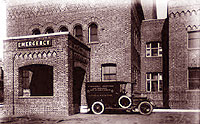
During training, trauma care was the center of the world, the cauldron in which the steel of the surgeon was annealed. At every level of training, and especially as Chief Resident, my involvement in trauma care taught me more about surgery and surgical patients than any other time I spent in hospitals. I'm grateful and lucky to have put in several years, literally living there much of the time, at one of the (at the time, probably still) preƫminent trauma centers in the country. Brilliant and tough, my teachers at SFGH (actually, when I was there, the emergency wing looked like this) gave me my sense of duty and commitment to my patients, the ability to make difficult decisions and to take responsibility for them, an understanding of the sort of "digital" thinking that a surgeon needs in the operating room. From them I learned a lot of technique, too; but the frosting on that cake I really owe to another, a decidedly non-trauma surgeon, Vic Richards, a legendary innovator, surgeon of singular intelligence (M.D. at age twenty, give or take), and a significant figure in my book.

But in real life, trauma was a pain in the ass. Unlike training, when we waited hungrily for the next case to roll in, in practice it was by definition a disruption. Destroying an operative schedule, crashing a full office, or robbing a night of sleep before a fully scheduled next day -- those were the least of the problems created by a call to the ER. It was the circus of managing a complicated and unexpected case in a hospital not primarily devoted to such things. It was dragging in a bunch of reluctant other surgeons (depending on the problem) -- orthopods, neurosurgeons. And the worst were the MVAs, for that very reason: multiple organs, multiple docs. If I had to come in to see a trauma case, give me a tidy gunshot or stab wound every time.

And I DID see a few injuries to femoral arteries from those causes. And to much bigger and bleedier vessels than that.

Once I got over the frustration at having been called (I'm an orderly sort of guy), it was never hard to be swept into the torrent. There is unequaled immediacy to trauma care, a series of "yes-no" decisions, absent "maybes." Real time, instinctive, urgent in the extreme, it's invigorating. There's nothing like the intrusion of certain death, turned around and sent away by the coming together of everything you know, to give a sense of purpose. There's nothing like slashing into a dead man's chest, sticking a finger into his heart, and watching him awaken even as your hand is beyond the wrist into him.

And I can do without it just fine.

Friday, June 26, 2009

Gotcha. Not.


From a commenter:

I think as long as Obama admits that he wouldn't subject his own family to the limitations he proposes for everyone else, his plan will fail.

Regards,
A Better Angel
I assume he/she refers to comments by Obama during the recent ABC News "town hall" held at the White House, in which there was this exchange, edited selectively in many "news" sites:

"Q: If your wife or your daughter became seriously ill, and things were not going well, and the plan physicians told you they were doing everything that could be done, and you sought out opinions from some medical leaders in major centers and they said there's another option you should pursue, but it was not covered in the plan, would you potentially sacrifice the health of your family for the greater good of insuring millions or would you do everything you possibly could as a father and husband to get the best health care and outcome for your family?

OBAMA: [....] I think families all across America are going through decisions like that all the time, and you're absolutely right that if it's my family member, my wife, if it's my children, if it's my grandmother, I always want them to get the very best care.

Predictably, this has been jumped on by detractors and touted in pretty much the way the commenter did: Obama's plan is good for your family but not for his, says Obama. Since we all love our country and don't wish our President to fail, I'm sure it was just an honest misunderstanding. Like my snippet above, most of the criticism leaves out the President's next sentence:

...but here's the problem that we have in our current health care system. Is that there is a whole bunch of care that's being provided that every study, every bit of evidence that we have indicates may not be making us healthier.

Which, of course, is the most important thing he said.

First of all, the wording of the question was, well, questionable. It's a false premise. It implies there are "plan physicians." It implies that treatments recommended by "medical leaders in major centers" wouldn't be part of "the plan." There's simply no reason to think either is true. There isn't, as far as I know, a proposal to separate "plan physicians" from others. And there most certainly is NOT an implication that therapies that carry the weight of "leaders" in "major centers" would be off the list. The opposite is true.

And it's exactly the point Obama was making. But it's neither sound-bite worthy nor easily explained; and, as we've seen, it's very much selectivequotable and outofcontextable. (Incidentally, that he got tough questions like that sort of shows the right wing fury (ie, Fox News) over the "unprecedented access" ABC was granted was so much hot air...)

Among the many ways to control health care costs is to establish what works and what doesn't. As I've written, severally. Patients and families, as President Obama said, face such dilemmas all the time. "The very best care," he said. Exactly. Would that it were always as easy as the example that the questioner (a doctor) gave, in which there would be general agreement from the creme de la medical creme. (It'd have been better if Obama had pointed that out: again, showing the session was hardly planned and canned.) On the contrary. It's often a decision involving futile care: the operation with a one in a million chance of helping; prolonging life in the ICU; trying dangerous drugs with virtually no chance of helping. Or -- and one assumes this would not be covered, since it currently isn't -- heading to Mexico (or, like Farrah Fawcett, to Germany) for entirely bogus treatments.

These sorts of things are, in my opinion, way too difficult for our political system, as currently manifested, to handle. Rather, at best (if that's what to call it), we'll get a plan to pay for insurance for those who can't afford it, leaving the excess costs of insurance untouched and not tackling effectiveness in any meaningful way at all.

But, perhaps, we could at least do it or not, without deliberately taking out of context what the President said.

Yeah.

Right.

Sampler

Moving this post to the head of the list, I present a recently expanded sampling of what this blog has been about. Occasional rant aside, i...