Where was I? Something about trauma centers....
So this Level Two thing was occurring at a time when the hospital was in a major funk. Nurses, as I said, were feeling lousy. Care was spotty, despite the presence of a bunch of the best nurses I'd known: they were overwhelmed with work, frustrated by lack of support. And despite this, because of the combination of sustained growth in our area, and the recent converting of many of the beds in the former competition to long-term care, the hospital was jam-packed much of the time. Having made commitments to using those beds across town for other purposes, and still running deficits, locked into an old building, the options for increasing bed space were few. And weren't happening. The ER (soon to become a high-level joint, evidently) was not rarely on "diversion," meaning the medics were told not to bring in new patients because there were no beds in which to put them. Elective operations were occasionally cancelled. Postoperative patients were sometimes kept in the recovery room for hours or overnight because there was no place to send them. Patients who might have otherwise gone to the ICU (intensive care unit) were kept there as well, for the same reasons. So among the least important issues for administration was attracting more patients. Patients, they had up the wazoo.
One more piece of the puzzle: trauma is, mostly, a money-loser for hospitals. Following a rule mentioned in a
book I recommend, trauma happens to people who are asking for it (more of a county hospital rule, actually, but still...), meaning they have no insurance and governments don't pay well for them. Off the top of the head, it wouldn't seem like a desirable thing for a hospital already hurting financially. And this: whereas trauma is the lifeblood of surgical training, and something people in surgical training love, for most surgeons in busy practice (which describes all the town docs, clinic or not), it's not always welcome. If it happens in the night, it means you face the next day's schedule tired; if during the day, it throws already-busy schedules into chaos. Because unlike training (as described in a particular
book), where the trauma service hangs around waiting to receive the next case, in practice you have a million other things to do. So the idea of doing more trauma, and having, on the days you were the designated trauma doc, basically to write off the whole day so as to be available by the rules of Level Two, was received -- let's see -- unenthusiastically. The anesthesia docs were similarly hypo-ebullient. Unlike any other issue including what time it was, on this everyone agreed, across all party lines.
Seeing danger down the road if its reputation didn't improve (several smaller hospitals line the periphery of the area, and they were salivating), the hospital embarked on an all-out effort to...... market itself. Not address care issues (OK, it's not as if they were totally unaware or making no attempts at all: but cost-cutting was the
ne plus ultra, so not much was becoming apparent.) Marketing was where it was at.
I'm guessing the person who came up with it didn't last long in the advertising game, but the new slogan up with which the hospital came was "Nobody Cares More." Banners and posters appeared all over the hospital, and, of course, in TV and newspaper ads. I suppose you can guess how the hospital ones were defaced, in short order (not by me, I'd add: too mundane): Either the "More" was crossed out, or "Any" was added between Cares and More. Among the staff, it was a running joke. And it bears remembering, for later on.
I may have exaggerated when I said the move toward a Level Two Trauma Center united the medical staff. Fact is, since it didn't affect a lot of docs one way or the other, they didn't care. But those most affected -- surgeons of many specialties, and anesthesiologists -- were horrified at the prospect, and were of one voice in expressing their displeasure. And truly, it wasn't just about the work-load. It was very, very much also about concern over the hospital's ability to provide the resources to do it right, and the fact that the best around was within shouting distance. I wasn't the only one who'd had experiences like the one I described. But of this "one voice" it must be said that one vocal chord was
paralyzed. That's because half of the docs in town, as mentioned earlier, were in bed with the hospital. So much so that if the hospital CEO had gotten the clap, they'd all have had to take penicillin. So much so that when they walked into the hospital, they were handed tubes of KY jelly. So -- and don't doubt that administration didn't know this very well -- when the hospital did something that the medical staff didn't like, half the staff kept their mouths shut. And the medical staff officers pretty much spent their time sending out memos telling us what plans the hospital had, with no input and no feedback. Puppet government? Puppet something: government seems a little generous.
So I was elected. The surgery department of the medical staff consisted of all surgeons in town, regardless of affiliation. Everyone knew I'd speak out and would say what was on all their minds, while allowing the rest to sit mute and enjoy deniability. "Sid, go talk to the CEO, and tell him why it's a bad idea," they all said, to man. And a couple of women. Give 'em hell, while we lube up. A meeting was scheduled with me, the CEO, and the hospital medical director. Armed with a well-prepared list of questions and issues that needed addressing, I spoke my piece, and was surprised by the candor of the response. "It's about market share, doctor. Our business plan is to be the referral center for the area, and being a level two trauma center will impress people, convince them we're the real deal." Or words to that effect. "Market share" is a verbatim quote. Providing service to the community was never mentioned, per se. What arguments did I have to counter "market share?"
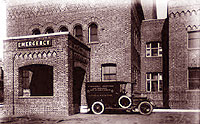
The one thing they had done is to spiff up the ER a little: made it bigger, bought a couple of cool monitors. New paint. Being the second busiest ER in the whole state, it needed it, trauma center or no. What they hadn't done is make any effort to get the surgeons, et al, on board; no need, really. They held the cards, in terms of doling out staff privileges, and they had the other guys by the balls, and by whatever parts were available on the feminine side of the equation.
As I was talking with the rest of the surgical department and considering how to deal with the inevitable, what steps could be taken at least to ensure the best care possible, the hospital started running ads in the newspapers, when the paint was dry in the new ER. Here's an exact quote: "State of the art in every way, the ER is backed by an acute care hospital... We all hope that life-threatening traumas and illnesses never befall us or our loved ones. But if the unthinkable happens, isn't it nice to know that the very best help is available, right here at home." Let's be clear: "state of the art" does not mean Xray facilities five hallways away from the ER and which may or not be available, lack of onsite lab, or absence of clear protocols for handling given situations. The ad also listed the services available at the hospital. On the list was the term: Trauma Center. I suppose I can be self-righteous. I'm a surgeon, after all. But this really struck me as awful. To call the facility a trauma center, and to claim it was state of the art and that the very best help was available was, in my opinion, fraudulent. Premature at the very, VERY least. So I wrote a letter to the medical staff president and his executive committee. I included a copy of the offending ad, and said I thought it was time for the medical staff to step up and take a stand. Going ahead with a trauma center was a decision that seemed to have been made; but there was no reason we should be silent in the face of false advertising. I got a letter back. You shouldn't write letters like that, was the gist of it. My within-the-system wad was shot, I figured. I'd gone to meetings, I'd written letters, I'd talked formally and informally to administrators, physician officers. I felt the hospital was behaving as if all it had to do to be a trauma center was to hang up a sign in front of the ER. I'd lost the war.
So I distributed a memo to all of the doctors at the hospital. Put it in their mailboxes. From which it got pulled so fast hardly anyone saw it....