Monday, April 14, 2008

SurgeXperiences


By appealing to my baser instincts, namely susceptibility to flattery, Jeffrey Leow has cajoled or tricked me into agreeing to host the next SurgeXperiences. So consider this a call for submissions (in the other sense, as opposed to how I submitted to Jeffrey's third or fourth entreaty.) Here is an official announcement (ripped off and slightly modified from Suture for a Living):

"SurgeXperiences is a blog carnival about surgically-related blogs. It is open to all (surgeon, nurse, anesthesia, patient, etc) who have a surgical blog or article to submit. The next edition will be on April 27th. The deadline for submissions will be April 25th. Please submit your posts here."

Having complained previously about themed blog carnivals (while acknowledging that people have a perfect right to do it however they choose), I'm making no suggestions other than getting your entries in on time. Unless an unprecedented deluge leads to more than I can handle, I plan to link 'em all up. So feel free, and freed. And please: lower your expectations.

Saturday, April 12, 2008

The Truth Will Set Us... Upon Ourselves


[Another weekend political rant. Stay away. It's all downhill from here.]


How many people would agree that the Republicans have been brilliant at getting the average person to vote against his or her own interests? (Hint: I would.) Knowing that their actual agenda of giveaways to the wealthy wouldn't fly on its own, they've managed to get people to think that this country will live or die over gay marriage and gun laws. So along comes a politician who points this out, and it becomes 24-hour news, drowning out the fact that the president admits, finally, that he authorized torture; wiping off the public consciousness the deficits, the war, the health care problems. Barack Obama said something that takes more than two seconds to explain, and the media and his opposing politicians go crazy.

I'm not sure about John McCain, but I do think Hillary Clinton is smart enough to understand what he said. The talking heads on radio and TV? Part stupidity and part cynicism. But Hillary knows, and plows ahead anyway. And what was it that Senator Obama actually said?

Government has failed to deliver to the average person, he said. It makes people frustrated and angry. By exploiting those feelings, politicians manage to get people to look away from their leaders' failings or their plutocratic agenda and to vote for them anyway, by sleight of hand. When people feel bad about their situation, they tend to look for issues to make them feel better. Immigrations, guns, gays. Is this untrue?

Okay, I admit he said it awkwardly. He's admitted it, too. But his words were "elitist" or "out of touch" only to those who willfully or stupidly misconstrued them. In the case of Hillary and her supporters, it's willful. Nor did he make stuff up out of whole cloth, like, say, bullets in Bosnia. He made a sophisticated point about how people think and how the political system exploits it. If anything shows how much change is needed, it's his words and the bullshit-filled reactions to them.

The spectacle of CNN and its ilk making 24 hour shrieking punditry out if it, finding it more important than all the problems facing us, is dispiriting beyond my ability to tell it. Between the cynicism of our politicians and the mendacity of our media, the American political system has become incapable of self-correction. We have, ultimately, no one to blame but ourselves. We elect the idiots, we watch the networks. Comes a person who actually thinks it's possible to change how we do our national business, and he's set upon by those for whom the status quo is their life-blood, while the people who have most to gain or lose are too complacent, or too burnt out, or too disappointed to make the effort to push back. They buy the crap because they've stopped believing there's anything else. More's the pity. The audacity of hope meets the beat-down of burnout.

Tuesday, April 08, 2008

Numbers Game


In the military they graded you on everything, and you graded those of rank below yours. Drafted out of training at the end of my internship, before flying off to Vietnam I headed to San Antonio to learn what makes a Flight Surgeon (after a brief stop in Bellingham Washington to get married; the timing, one could argue, was poor, if optimistic, but it seems to have worked out.) During the sojourn at Brooks AFB, in addition to sinus blocks, decompression chambers, water-survival, altitude sickness, G-suits, and the self-injection of antidotes to toxic gas, we were taught the way the evaluation game was played. Specifically, we were instructed what not to do.

Careers can be unmade by those forms. Listing all manner of attributes, to be rated in numbers running from 'one' (for performance worse than would be done by a cold corpse) to 'ten' (ostensibly for attributes seen only in the divinely touched, but in practice doled out like drinks at the Officers' Club), the forms needed filling annually. For officers, there were OERs, for "Officer Efficiency Report (or was it "Rating?")" For enlisted personnel, it was A-something-something, for Airman something something. As draftee docs, none planning on a military career, we were made to understand it was not our place to screw up anyone's future; most especially that of a lifer. The default grade, in other words, was 10. Or, in extreme circumstances, 9.

I had no problem with it. In fact, I had more difficulty with the idea that I was about to be someone's boss. (In reality, of course, I wasn't. Anyone who's been in the military knows a good NCO runs the show in any given shop. I found mine, and hung on for dear life.) The ultimate example of the "shit runs downhill" phenomenon, internship hardly qualifies as ego-supportive. I'd never been in the position of judging anyone in any impactful way (plenty of experience in being judged), and I had no desire to start at that lowly point in my career. Tens it was. On the other hand, I got a nine once, and the hospital commander was concerned enough to call me in to tell me about it.

With a look of fatherly disappointment on his face, the Colonel told me that on my OER (this was while still in Vietnam) I'd gotten -- having otherwise run the table with tens -- a nine in the matter of "military deportment." Which translates into saluting a little less crisply than the manual describes, and maybe having a little more hair touching my ears than specified. No matter that by all measures medical I was in the perfect category, and no matter that a nine was, theoretically, equivalent to walking on water but maybe getting your ankles a little wet. Damn near perfect, so you'd think. But the concern was that, were I to choose a career in military medicine, such a blight could besmirch it, and I should deign to develop my demeanor, amplify my attitude. Shine my jungle combat boots, presumably. Kiss me some colonel ass; administer a high colonelic.

Other than the telling of an amusing story, my point here is that measurement of performance is difficult and distorted; perverse, even. This, it turns out, applies not only to those charged with protecting the life of our nation, but to those protecting the lives of patients. In the military we had hospital inspections regularly, by several inspectors general from several command levels. Every month or so, it seemed, there were people wandering around the facility with clipboards. Our preparation? Buffing the books, polishing the paperwork. It's not that much different in civilian medical life. What's looked at, because it's easiest, are protocols and procedures, bound in binders. Are the boxes checked: at what time was the antibiotic noted as given in relation to the surgical incision? What forms were filled before the patient went to sleep?

I think there's not the same pressure in civilian life, as there was in the military, to bend toward favorable reviews. The opposite, in fact, is becoming the way: guilt is presumed over innocence; punishment preferred over finding and correcting the process that led to an error. Accreditators want to see a few scalps hanging on a few hooks.

Near the end of my military service, having been sent to Vietnam after being told I'd not be; having found, at first, that I wasn't needed when I got there (not for a while, anyway); having endured the broken promise of first choice assignment on returning home, and having witnessed the randomness with which doctors were matched to their skills, I got a call from a high-ranking officer who tried to convince me to stay in. "Yer thuh kahnda ofzer whur lookn fer, See-id." Really? With a nine on my record? But I wonder: given the difference between their kind of evaluation and the ones crawling up our legs in the civilian world: might I have ended up happier had I stayed?

Monday, April 07, 2008

The Death of Health Care


In today's New York Times there's an article that addresses something I've argued for a long time: the way to control costs of health care is to look at how and why costs and practices differ, and to adopt the best practices.

Now this article in particular is about the costs of end-of-life care, which is tricky. Even better, though, as a point of discussion, because it's been shown that a huge amount of the health care dollar is spent in the last months of life. Were this area looked at -- really looked at -- we'd have a paradigm in which to figure out what we really want from our health care money. About 30% of Medicare money is spent in the last year of life. Of that, 40% is spent in the last month. It's not surprising, of course: you tend to be sick before you die. So one would hope. Still, it would seem that in the variations described in the NYT article, there's much to be learned. Is it the same care being delivered more efficiently? Is it philosophical?

I don't know the answer, and I've already posted once today, so I'll wax waningly. I'm just saying that it's about time to turn our attention to where the real money is and have a little candid politicking. Candidates propose ways to fund insurance. Scheduled to go into effect this year and next are major cuts in physician payments by Medicare. Politically popular. Easy. And looking exactly 180 degrees away from the heart of the matter.

The Truth; Students, Be Warned

Saturday, April 05, 2008

No I Can't


Stand the process, that is. Will Rogers said he wasn't a member of any organized political party, he was a Democrat. Man, oh man, was he right.

[This is a political rant, but one that's unlikely to offend many, if any.]

At the Washington State caucus in February, I was elected delegate to the next level; the meeting was today. At that earlier gathering, despite the frustrating disorganization and very poor choice of venue, I decided I'd like to keep moving on up -- from the local level, to the district level, to the county and maybe even to the state level. Get a long shot at going to the national convention. Gave a little speech, got selected. But today, I bailed.

"Democracy is messy," said Donald Rumsfeld. His words were uttered while Iraqis were looting their country in the first signs of the lawlessness that was to follow our invasion. In that, and maybe only that, Rummy was right. (Of course, the example he chose was, in fact, anarchy, not democracy. That may be explained by the fact that no one in Bush's executive branch seems actually to believe in democracy, much less recognize it.) I'm no less committed to electing Barack Obama than I was yesterday; but I sure as hell lost any delusions of being able to sit still for the electoral process in the caucus system as I've witnessed it. I expected a long slog, but this was beyond excusable, even if participatory democracy is inherently inefficient. All I can say is, if Senator Obama ran his campaign the way my legislative district runs a caucus, he'd have been toast months ago. Having actually enjoyed the two caucuses in which I'd previously participated -- talking to neighbors who were similarly immersed in politics and at least as well informed -- I'd now be first in line to vote to replace them with direct election. Grassroots is one thing; absolute lack of planning is quite another. (Nor am I sure disproportionate voting influence should go to those able to stick out such tedium. For what, I wonder, does that select?)

With separate tables for various groups of precincts, the sign-in went quite well. But when the ink was dry, it was as if no one had considered anything else. They ran low on ballots. Information packets were, it seemed, randomly filled with papers. People weren't told clearly how to divide up (Hillary supporters on one side, Barack on the other. Delegates here, alternates there.) After sitting a while, we were asked if anyone else wanted to sign up to run for delegate for the next level. I hadn't been told there was a need or a way in the first place. So then I did. For the two candidate groups, all in the same room, there was one microphone, and enough din that it was hard to be heard without one. As people tried to get something accomplished during the wait, it was announced no business could be conducted until the credentials committee counted those who'd signed in, certified them, and designated alternates for those who hadn't showed. Two and a half hours in, still no word from them, except for a call for volunteers to help count (this was after the two-hour mark.) Counters? No one had planned for the needed number? I'd guess the total assemblage was in the three- or four-hundred range, not all of whom were actual delegates. I couldn't figure what was going on that could take so long. But I was surprised to find that the number of delegates assigned to each candidate would no longer be based on the original caucus numbers, but on the number who came today. So, despite about a 2:1 advantage for Obama in February, had, say, 10 showed up today for him and 20 for Clinton, the new distribution would have been reversed. It didn't happen, far as I can tell (I didn't stay for the final accounting, but the numbers in the two groups seemed at least as skewed toward Barack as before, if not more), but it hardly seems consistent with the idea of democracy.

There was an ambitious agenda; the main goal was to elect delegates for the county convention, but there were rules to adopt, votes of various sorts to be taken. Still we waited for the credentials report. And waited. It was announced that there were diabetics who needed to eat. No food was allowed in the auditorium, but there were vending machines. Did people want to leave for food? For how long, until the report? Names of those running for delegate were taped to the walls in lists of about ten; there were about fifteen lists. Each of the 150 people was to have one minute to speak, but there was no beginning in sight, let alone an end. People shouted suggestions, counter arguments were flung. Chairpeople were to be selected for each group before hearing from delegate candidates; people who wanted to chair the groups came forward, but couldn't do anything until the credentialing was complete, even though it was clear who'd signed in, and the job would only last the day. People were called to gather closer, to be able to hear; that left the disabled behind, and there were protests. We'd started at 10:00 am; it was now nearly 1 pm. On the program, it said adjournment would be no later than 4 pm. No way that could be met.

I had an epiphany. There were people in attendance more able than I to stand it, more committed to the process, less annoyed by the carelessness. They should be the ones. The surgeon in me said, this is the sort of planning that kills people. Or at least drives some (me) irreversibly crazy. So, after confirming that leaving wouldn't affect the delegate distribution (it was based on the initial sign-in), I found a magic marker, crossed my name off the list, and slinked (slank? slunk?) out the door. I'll send Barack Obama more money. That I can handle. If the market levels off.

Friday, April 04, 2008

Nature Boy


We are fortunate to live in a house perched on the edge of Puget Sound, on a high bank, looking north. Whidbey Island is in our view, as is Mount Baker, and the waters leading toward Deception Pass. Craning our necks a little, we can also see the Olympic Mountains. Winter or Summer, clear or storming, the view constantly changes. Sometimes the waters are flat and reflect the clouds (as in the title picture of this blog); sometimes winds blast down from the North, pushing waves and froth in our direction, and driving boats to struggle their way back to harbor. Tugs go by. We can hear them. Sometimes it's Navy ships, including an aircraft carrier once or twice a year; decked with planes and sailors in their whites. There's a pair of big red and white tugs, double-ended and always brilliantly clean, of the large ocean-going type that I see often. Many more, including one or two that are so tiny as to seem useless -- except that they aren't -- chuggle the waters, too. One is lugging a flotilla of logs as I type: it's churning the water behind it into a fine froth, struggling. The log raft is a hundred yards long, at least. When the weather gets a little warmer, the rafts will sport hitchhikers; dozens of sea lions fatly sunning a free ride into town. Seals for some reason (maybe they're unwelcome) seem only to swim by, never taking a ride. Our windows are open in the summer, and the barking often wakes us up. If the birds haven't.

When I was working, most days I left home in the dark, and returned in the darker. Although this house (which we've remodeled in one of our more successful creative endeavors) and its view were as much a part of what attracted me here as my wife's family and the job itself, it's not been until fairly recently that I've been able to enjoy it as much as I now do. I've seen seals catch salmon and flip them up vertical, then slug them down their gullets in one slide, disappointing the seagulls hanging by. Regularly in view are bald eagles, flying right at eye level just off our bank; sometimes with prey in their talons, their screech no longer surprising, but still thrilling. Cats need to be careful. The eagles nest about fifty yards away in a dead tree; we've watched babies pop their heads up, fledge, fly away. Juveniles have perched in our cedar tree, right outside the window.

Ferries are within view, on both sides of their route, leaving more or less at the same time from each dock, occasionally having to divert around tugs or the Navy. We used to walk down on Sunday mornings and take a ride over and back for breakfast, just for the view it affords of the water and mountains. Visitors got the same routine.

I mention all this only because a few moments ago there were gray whales spouting out there. They're usually -- as they were today -- far enough away that you don't get a great view: spouts, sometimes a bit of a back. Once, though, one came right to the bank and stayed for a while, blast-breathing right in front of the house. Orca pods, half dozen or more in a group, go by once in a while. Whale sightings aren't real common from right here, so it's a treat when it happens. Nothing much to do with surgery, really, other than that it's in the obverse that I now have time to observe.

[I guess I should add that as of a year or so ago, there's now a huge industrial pier in front of our house, the pile-driving for which intruded on our peace and rattled our house for many months, and on top of which there was just added an enormous crane that wheels out and back to the warning sound of a siren. When at the end of the dock it looms red-eyed (two big lights) into our view. So nothing's perfect. But really, I still can't complain.]

Thursday, April 03, 2008

(S)TRAINING


Just got the latest issue of ABS News, the newsletter of the American Board of Surgery, which is the agency by which surgeons are certified as qualified to practice their craft. Reading it was disquieting.

The ramifications of the recently mandated decrease in the training hours of residents is a subject covered by many medbloggers, including me. And me. The clear inference from the newsletter is that one's fears are being realized: surgical residents, it seems, are getting diminished experience. It's these words that tell the tale:

"The ABS convened a meeting...to examine in depth the rapid growth of gastrointestinal surgery fellowships....to consider the potential reasons residents feel the need to pursue these fellowships and their effect on residency training. The principal outcome of the meeting was that the ABS should work to establish specific standards for the training of residents in GI surgery, including a core set of operations that residents should be competent to perform by completion of residency, to assure that residents obtain sufficient GI surgery experience.... (T)he ABS has examined residents' operative data from recent years which reveal insufficient case numbers for many core GI procedures.... many (laparoscopic procedures) appear to still be considered the domain of fellows when they could be done by senior residents. This...leads residents to enter fellowships..., thus continuing the cycle.... (D)ata also show a decrease in resident's participation as second and first assistant, perhaps signifying that residents are also receiving fewer opportunities to observe procedures before performing one themselves... ...ABS will explore establishing minimum case numbers...as well as a certain level of competency in the care of underlying diseases..."

Elsewhere in the same issue is an article on "Redefining General Surgery," in the context of what a training program curriculum ought to entail. Here's an excerpt:

"Phase 1 of the curriculum has been completed and focuses on 20 basic surgical skills, such as inserting a central line, suturing and knot-tying."

"Well," some might ask. "Isn't this a good thing? Ought not there be standards?" Yes, of course. But until recently, some things went without saying. What is general surgery training if it doesn't produce people ready to do gastroenterological surgery? In the era of my training (he said, proving he's an old fart and sounding like your grandfather claiming to have walked to school uphill both ways), whatever else was true there was never any doubt we'd be getting plenty of experience in such an elemental essence of general surgery. I won't argue that every surgeon coming out of training from every program in every year since time began was adequately taught; nor would I deny that there never has been a perfect way to measure skill and knowledge. (Passing the "Boards" requires both written and oral exams, and the provision of a list of operations done in training; but it doesn't have a means for observation in vivo. Fellowship in the American College of Surgeons requires lists and interview and testimonials, but I can't pretend it's supercalifragilistically rigorous.) That training requirements need to be readdressed, when a few years ago they didn't, means either that we were kidding ourselves back then, or there are big problems now. Maybe it's both; if so, I'd say it breaks out at about 20 - 80. Or 10 - 90.

Suturing? Knot tying??? THAT needs confirming???!!! Holy shit, is what I say. Holy actual steaming shit.

[After writing the above, I was speaking with a good friend in the upper echelons of academic surgery. He said he considers the 80 hour week only a part of a larger trend over the past few years, namely the fragmenting of general surgery into its component parts. Trainees are heading off into many subspecialties which have fellowships (not all of which are certified or regulated from the outside -- a significant but separate issue), whether laparoscopic surgery, or colo-rectal, or oncologic -- not to mention the specialties that once were all part of general surgery: thoracic, vascular, urologic, etc. There are even breast surgery "fellowships!" To me, it seems comparable to auto mechanics needing extra course work in opening hoods. In more and more institutions, the formerly core work of any residency is done by fellows, leaving the surgical residents with less and less experience (and fewer hours in which to find it). This is the point of the article to which I referred above, but it's about more than just gastroenterologic surgery, in my friend's view. And there are other interesting consequences: in many hospitals surgeons practice only in their narrow subspecialty, refusing to take call in the broader general surgical areas, even though they generally request broader privileges. More strain on surgeons like me, and patients like you. The endpoint seems obvious.

And yeah, my friend said: they have interns who, at the end of a year, can't tie knots.]

Tuesday, April 01, 2008

Trake It Or Leave It


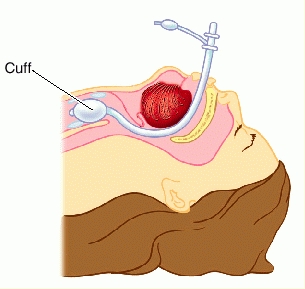
I've only had to do one emergency tracheostomy, and it was scary. On the other hand, I've done many a trach (pronounced "trake") less emergently, and it can still be a little frightening, even on a pink patient. Not to mention the potential for turning into a circus.

I view it as community service. Taking only a few minutes of operative time and reimbursed as if it took even less, the whole rigmarole potentially requires all sorts of extra, non-operative, effort. In the typical situation, the patient is in the intensive care unit, mechanically ventilated via an endotracheal tube passing either through the nose or mouth. At some point the tube becomes intolerably uncomfortable and/or potentially damaging to the tissues through which it passes. In addition, it's hard to suction properly (which is necessary because such patients can't cough stuff up on their own) through such a long pipe. So the surgeon is called to switch the patient over to a tracheostomy. It's more comfortable and allows easier hygiene and airway maintenance. [Aside: there's nothing more annoying than getting the "request" via an order written in the chart by the attending physician saying, "On call surgeon to perform tracheostomy." Like ordering a blood test; how inexcusably rude!! It always pissed me off. Depending on my mood and how well I knew the nurse calling me (some quite understood), I might respond that if Dr Soandso wishes me to see his patient, he can damn well call me and say so. Or I'd just grumble in my gut and go do it.]

Often the patient is unable to sign for or understand the procedure. The family needs tracking down, meetings set up. Transporting a patient on a ventilator -- with a fertile bloom of accompanying other tubes and monitors, several IVs, compression boots, precarious arterial lines -- to the operating room requires coordination with respiratory therapy and/or anesthesia, arranging for a couple of nurses to accompany, and to time it such that the patient travels straight from the ICU to the actual operating room, with no stop in a holding area. It's usually a fairly well worked-out process; still, there are risks and worries. In any case, in terms of time, hassle and worry versus reward, there's not much in it for me. Community service, as I said.

In training, on the cardiac service, we did our trachs in the ICU, under local, with a scrub nurse from the OR, a full instrument pack, a portable operating light, and with an anesthesiologist present as well. The belief was that potential risk of doing it outside the OR was balanced by eliminating the hazards of travel. I'm ambivalent about that, but it was good practice. I learned to do it with a very small incision, and in what I think is a very safe way. Nevertheless, in all the hospitals at which I practiced after training, ICU trachs weren't allowed. They all had stories...

The operation can usually be done though a small incision, one that hides behind the "shield" part of the tracheostomy tube. There are a few tricks, starting with proper positioning. Doing it while the patient remains in the hospital bed is possible, but unpleasant. Because of the width, you have to lean over too far, and it makes the back of the knees hurt like hell. Transferring to the OR table, though, presents a risky moment or two, potentially dislodging this or that, but is, probably, preferable. Either way, rolls of some sort are placed behind the lower neck or upper back so the neck is extended. Sometimes it doesn't help much: people with thick and short necks can be a nightmare, as can those with big thyroids. Conversely, those with necks like a swan, lithe and lanky and thin and graceful, landmarks visible across the room, are worth the logistical struggle just for the pleasure...

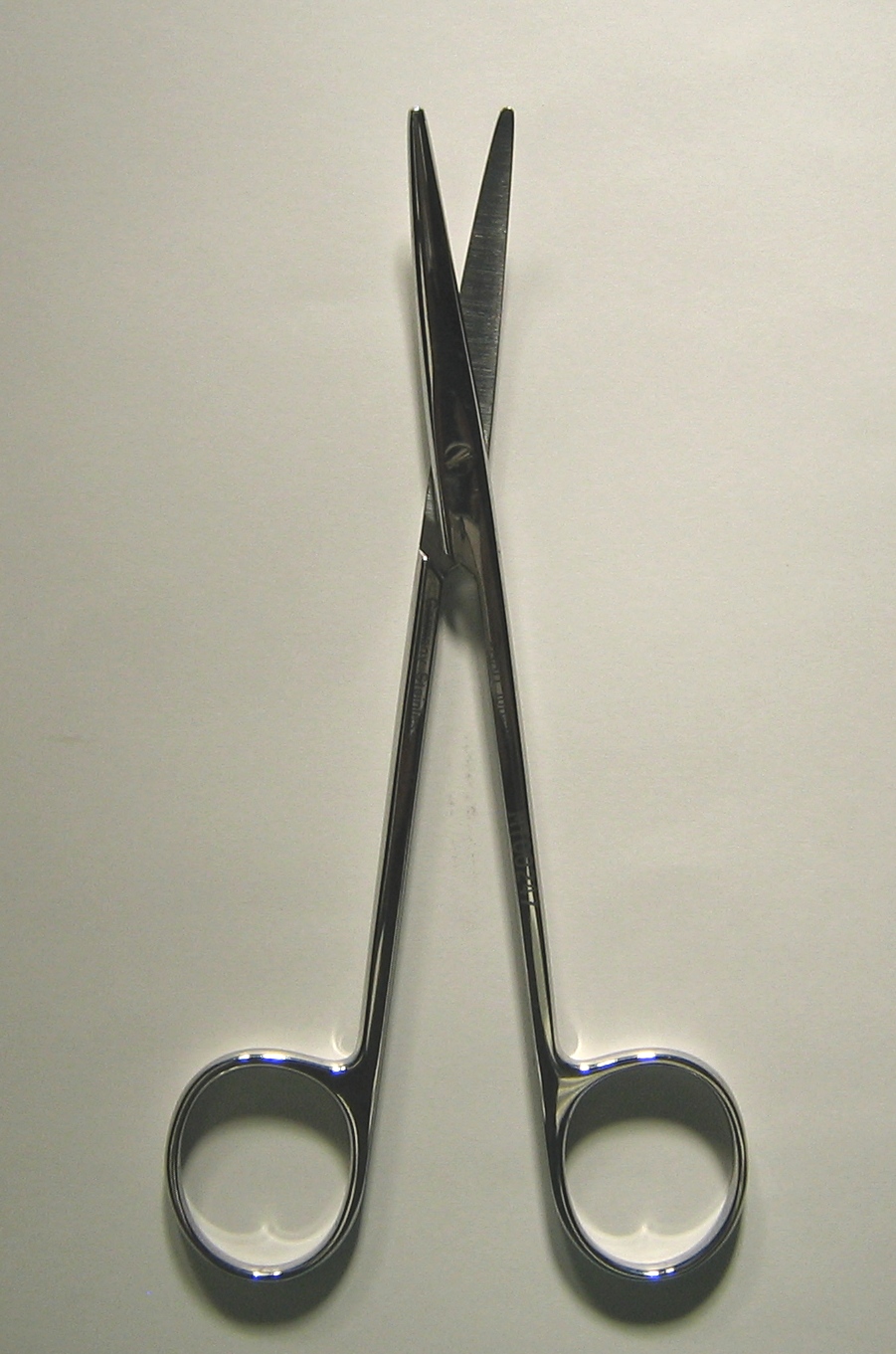
The three most important technical issues are these: 1) after making the incision, dissect exactly in the midline (thin=easy; thick=not so much), spreading Metzenbaum scissors vertically only, all the way down to the trachea; 2) use Army-Navy retractors in the wound as it's deepened, one on each side, pulling laterally, to expose; and 3) when the proper location (the first tracheal ring) has been exposed, place fat silk (or any other non-absorbable and soft) sutures, one on either side of the midline of the cartilage, before incising the ring. They make great handles for traction when inserting the tube, and leaving them for a few days facilitates replacement if necessary. Especially if needed in a hurry.

The meat of the operation is the actual insertion of the tube. It's a dance with the anesthesia person: after incising the trachea and lifting on the sutures, you watch closely as the person at the head of the table slowly pulls the endotracheal tube back, until the tip of it is just above your incision. At this point, the patient is no longer being ventilated, because the air/gas being squeezed in is rushing out the hole in the trachea (you smell it; environmental rules are suspended). Sometimes there's coughing, and mucus blowing out the hole. Because of the forward curve of the trach tube, and of the backward curve of the trachea itself, the tube must be inserted sideways and then twisted and plunged downward -- without tearing the balloon on the cut edge of tracheal ring. Depending on the respiratory needs of the patient, this moment can be tense. Rarely, you need to regroup and have the anesthetist re-advance the existing tube. But once the trach is seated, which is usually very quick and smooth, it's all over. No need for suturing (assuming you made the incision properly small); just receive the ventilator hose from the anesthetist, plug it onto the tracheostomy tube and exhale, tension dissipated like breath in a cold breeze. Then tie it in place with twill tape around the neck, and call it a day. Except for wheeling the patient back to the ICU, explaining to the nurse why those sutures are hanging out, and telling the family that everything is okay.

[For a couple of harrowing tracheostomy tales, with diametrical outcomes, the reader is humbly referred to my book.]

Monday, March 31, 2008

Weekend by the Bay


Anyone remember this post? (To save you the trouble, it was about a friendship I made online, with a man who trained where I did about ten years earlier, and who eventually sent me a key to the fabled and loved Chief Resident room in the fabled and loved San Francisco General Hospital, of which I was the last occupier before it was torn down.) We've corresponded for over a year, but until Saturday, we'd never met.

This weekend in San Francisco a "distinguished professorship" in honor of one of the early Chiefs of Surgery at UCSF was celebrated. The professor died many years ago, while I was in training; in fact, I was a pall-bearer at his funeral. The professorship was financed by his daughter and her husband, the former being Dianne Feinstein, US Senator. Hosted by the two of them was a fancy dinner at a fancy hotel, with the attendees mostly surgeons who'd been trained by him, many years before me. There, I was the young guy.

Ordinarily I'd not be attracted to such a gathering; I feel out of place amongst strangers, especially those more glamorous than I (which includes pretty much everyone) and having connections to one another that don't include me. (We trained at the same place, but not at the same time.) But at the urging of JB -- the keymaster -- and with the knowledge that a couple of my old professors, now frail and failing and not likely to reappear, would be there, I took a one day trip to SF. Mostly, I'm glad I did, even though it began with a flight made stressful by that fearsome announcement midway to SFO: "If there is any medical person on board, please turn on your call light."

It wasn't the first time I've responded to such a plea. Stalling for a few seconds to see if any other lights went on, I chimed in with the reluctance that comes from fear of the unknown. A steward came and leaned to me (I'd noted his unusually cool and amusing delivery of the safety speech, and his friendly handling of the delay in takeoff occasioned by the usual SF morning weather.) "We have a lady who looks pretty gray. What sort of medical person are you," he asked. "I'm a physician," I replied. "A surgeon, actually. I could take out her appendix if needed." He smiled and led the way to the back of the plane.

In a seat leaning back as far as they go (meaning pretty much vertical) was a thirty-something woman looking indeed quite peaked, already with flimsy and ineffective-looking oxygen mask on her face but with an adequate albeit quite slow pulse, felt under the skin of a clammy wrist. I asked a few questions, determined that she was in prior fine health, no meds or allergies, no clots, had flown in the past with no problems. Ever notice how in the movies -- or even in televised fights of some kinds -- when a person goes down they sit him up, or even try to get him up walking? Pretty basic: when fainting or otherwise woozy, lie the hell down and stay there! Conveniently, the woman's seat was right across from the galley area. After the stewardess spent a couple minutes trying to remove the arm of the seat before discovering it wasn't designed to come off, I helped the lady (she was cognating marginally but able to supply a little leg work) over the armrest and onto the floor and kneeled down beside her, readjusted her silly mask and took the offered sphygmomanometer and stethoscope. There was, of course, no way to hear a damn thing in that rackety galley, but I checked her pressure by palpation and it was good enough. She'd picked up her pulse rate a little, too, complained that her fingers were tingling. About this time her friend came down the aisle and said they'd been out drinking a lot last night.

I was handed a headset. The crew had been in contact with the ground, connecting with some sort of emergency physician, with whom they wished me to speak. As I had when doing my required flying in Vietnam, sitting in the copilot seat and given control of stick and rudder, mic pressed against my lips properly near as confirmed by the frequent kissing of it (pilots did it, so I did, too, singing out "roger one-five-niner" and "rollout" while taking directions from the spies in the back of the plane), I donned the set and knowingly tucked the phone close to mouth. There was a button to push when talking. It was all so familiar... I gave my assessment, thumbing the button like a veteran, and the doc on earth said "sounds like a vagal thing." I agreed, but added that I thought there was a measure of dehydration, hung-overness, and hyperventilation.

"Think she can just check in with her own doc when she's on the ground?"

"Doubt it. She's better lying there, but I don't think she'll be getting up and out on her own power."

"OK, so you want EMTs there?"

"I think it's best."

After reassuring her that I was sure it wasn't serious, she was in no danger, there wasn't more I could do. Thought about getting her to drink some juice, but figured better to let her lie. I returned to my seat after filling out some forms; came back a couple of times to check on her. Interestingly, and rightly I'd say even though it probably broke some rules, they kept her lying there for the landing. We were held in our seats until the EMTs came aboard, checked her, exited and returned with a gurney/wheelchair hybrid (I felt vindicated at that point) and rolled her out. The stewardess thanked me earnestly, offered me a Starbuck's gift card as a reward. For five bucks.
A few hours later I met JB at my hotel. He was more compact and wiry than I'd have guessed. In his seventies, he bristled with contained energy, had a perfect voice: just grainy enough and quietly powerful, confident, in charge. He'd sat himself down with a couple of ladies in the lobby, unknown to him, and was chatting away when I came down, missing him at first, expecting him to be alone. His baldness was semi-encircled in the grandfatherly way. Obviously fit, wearing cowboy boots to the ball, and a Panama sort of hat sporting service medals and insigniae from his time in Vietnam (where, unlike me, he'd served as a fully trained surgeon, well in the thick of it, the real deal), he'd brought a copy of my book for signing. It was heavily annotated and curled from re-reading, underlined, with lists of questions at the back. I'd planned to tell him of my airborne adventure, but his stories were much better, and I lost mine in the moment. After the night's ceremonies and a detour into the bar for one more round, we parted company in a fully exchanged hug. Worth the trip. I want to spend more time with JB.

Saturday, March 29, 2008

Scar Trek, The Next Generation

[Weekend rant, a day early because I may be out of touch tomorrow. This is about religion. Be warned.]


My reaction to the above video goes beyond anger: it makes me sick. These kids are deliberately being deceived. Brainwashed. And, yes, abused. In the name of some religion or other, they are being told to reject verifiable fact; told to ignore explanations that are literally right in front of their noses; given permission -- no, being required -- to reject the idea of thinking for themselves. Indoctrinated. In the guise of teaching, their idiot instructor is making them parrot a catechism of cluelessness. The bible says it. End of discussion.

Chill, Sid. It's religion. We have to respect it. Freedom of religion is a foundation of our country. Right. But I don't see a need to acquiesce silently to the hijacking of minds too unformed to understand religions, let alone choose among them; nor do I see a need to approve of intellecticide. Comforting make-believe is one thing. It's quite another deliberately to remove your children's reality-testing, to close off whole parts of their brains. Because in addition to harming them, it affects me; it affects us all. These people may grow up to become voters (if they don't also reject the science of medicine and the wisdom of looking both ways before crossing the street). They are being led to extremism which differs not from the kind that creates believers in paradise filled with virgins. And we know where that leads. (By the way, is their virginity self-renewing? Because eternity is a relatively long time. Seventy-seven copulations would be over -- by my reckoning -- in a decade or two. Then what? If sex with virgins is worth dying for, it seems sort of over-promised and under-thought. And seriously exaggerated, total-experience-pleasure-and-talent-wise.)

By "extremism" I mean thinking which willfully rejects fact; I mean belief that flies in the face of reality -- not to mention into buildings. The above-displayed sort of belief and that suicidal extremism differ only slightly, if at all. The one leads easily to the other. What is it but extremism that has these men trying to inculcate in children that which is demonstrably false? I don't doubt their motives: and that's the point. I'm sure those guys fully believe what they are saying, just as much as the 9/11 hijackers believed they were going to promiscuous paradise. They think that in getting children to reject rational thought, implanting in their brains blocks to thinking for themselves (which they describe, entertainingly, as "thinking for themselves") they are doing something wonderful. Saving them. Sincerely. Which is what's so sickening. The smug certainty. The rectitude of wrong.

There are people in the world (I know some!) who are religious and who find a way to reconcile their beliefs with wonder at the way the world is, as opposed to needing to bolster belief by harboring plainly incompatible and disprovable dogma. When religion requires one to deny the world -- no matter how sincerely -- and gleefully to dimish the ability of one's children to think for themselves, it endangers me. It pollutes our nation with people incapable of the clear-heading thinking required of a democracy that works. These are the people putting religious tests to our potential leaders, proclaiming their holiness above mine, placing more importance on the words of a person's pastor than on that person's own words, banning books and destroying public education. Rioting over cartoons. These are the people claiming our country needs more religion, even as their religion-above-all attitude is subverting the very foundations of our democracy and aiming us toward societal failure by substituting indoctrination for education. It worries me that there's no future in the future. So yeah. It makes me sick.

Thursday, March 27, 2008

Cutting It Close


Shortly after I set up practice, my mom mentioned a little skin growth she wanted removed. Since she was part of paying for my college and med school (yes, I was one of the lucky ones!) I figured it was the least I could do. The lesion was a simple non-worrisome thing; removal was strictly cosmetic. But its orientation was such that I had to choose between a smaller excision, not in proper skin lines, versus a bigger one that might be less visible. For some reason, which I still can't understand thirty years later, I made the former choice, and it wasn't a very respectable scar. It did, however, lead me to pay much more attention to orientation; and to the realization that it had been under-emphasized in training. Little things like that are little things like that, when you are trying to learn how to remove half a liver.

But that's not my point. A recent post of mine, and comments thereon, led to thinking about operating on people to whom one is close. It's a close call. On several occasions I've operated on partners, or their family. I've operated on friends (it helps that I have few really close friends), and on people who came to me on the recommendation of friends. In-laws have been under my knife, if a small one. It's an interesting subject, a complicated one. To some extent, it depends on one's ability to compartmentalize. Or, more properly, to focus.

I've not considered it a matter of ethics; to me, it's about judgment. One of my commenters said she was taught in med school that caring for family is considered unethical; perhaps it's a semantic disagreement that we have. To me, "unethical" means submitting false charges, operating with no indications to collect the fee, taking kickbacks for using particular products (a matter of current investigation, evidently.) Were I to operate on someone close, the question is whether I could rise above emotion and make care decisions exactly in the way I would for a "normal" patient.

There's a strange implication here, when you think about it. I like getting to know my patients. Not only, as I've written, do I believe in the importance of establishing trust and confidence and a positive attitude, I just enjoy the relationship for its own sake. It could be said -- it is said, in fact -- that it's a mistake to have anything but a cold and distant relationship with one's patients. But if it's okay to reject that, if it's acceptable -- laudable, even, according to various patient advocates -- for doctors to establish and to have a connected relationship with their patients, then doesn't it follow that the idea of "professional distance" is a flawed one? Doesn't it imply I'd make better decisions when caring for a patient I don't like than for one I do? If not, then at best the idea of caring for a relative or close friend differs from caring for "regulars" only in degree; and a smaller degree, at that, than convention would suggest. Ethics, per se, are not the issue. Attitude is.

Perhaps I'm missing something, but I sort of reject the idea that I care less about my unrelated patients than I would about friends or family. Maybe I'm deluding myself in believing it, but when I enter the operating room I get into a zone of intensity and focus on the problem at hand that nearly obliterates everything else. Totally concerned about addressing the requirements of what I find, while I operate the personhood of my patient is no more and no less than that of the last one, or the next: I'm obliged to do my best. Period.

Of course, I'm not unaware of the temptation to think wishfully, to opt for a path less discomforting for a loved one; it's a possibility, to be sure, especially, perhaps, in after-care. Included in my "memorable patient" series is the story of operating, with only a couple of years of practice under my belt, on my partner. When I had to re-operate on him -- a decision which was harder in many ways than one to delay -- I deliberately chose as an assistant a surgeon out of my clinic, and told him ahead of time I wanted him to speak his mind. Not only was he among those that had suggested waiting, he also made a recommendation during the operation that I ended up rejecting. Later, he commended both of my decisions, and said he'd been wrong, twice. I was able, I'd argue, to think clearly about the needs of my patient irrespective of who he was.

It's not my aim to suggest that doctors ought to start caring for their loved ones; nor am I implying (I don't think so!) that I have mystical powers of concentration absent in others. But it wouldn't be the first time conventional wisdom was found wanting; at the least, it's not crazy-stupid to wonder about it. It's not impossible to focus. Like the paranoid who actually does have enemies, some doctors who think they could provide better care than their colleagues, even to loved ones, might actually be right in some instances. When he was a baby, it looked like my son might have had a hernia. I really liked the way I fixed pedi-hernias; no one in the area did it as simply or with as tiny an incision, sez me. (Most of the pediatricians I knew sent all of their hernia patients to me, because they thought so, too.) Had my son turned up with one -- he didn't -- I'd have been sorely tempted to do it myself, believing it would be in his best interest. My wife told me several times that if she had breast cancer, she'd want me to do the surgery. And having seen my work and that of others, I'd have considered it; probably I wouldn't have done it, but I'm not sure. Happily, I never needed to make the decision. Nor am I unaware of the egotistical implications of the pre-penultimate sentence of this paragraph.

Greater than the risk of providing improper care, as I see it, would be the burden to bear if something went wrong. In that, there would be a difference. It's hard enough to forgive oneself for error or poor outcome under any circumstances. It might be more than I could take, in someone close. Which, of course, argues strongly against taking it on, if for reasons somewhat different that those generally offered.

Maybe there's a happy medium. Plastic surgeon and rabid blogger Ramona Bates responded to my original post with one of her own, and she gave examples of what a surgeon can do to help in meaningful ways, while avoiding the potential pitfalls. When my dad needed surgery of the sort that I did, I had him come to town and hooked him up with a hand-picked team. I stuck my head in the room a couple of times and transmitted the information to my wife and mom. Same when my son had an orthopedic procedure. I was unobtrusive in the OR, helpful to my family, and felt useful in a surgical sort of way. Dayenu. As they say.

Tuesday, March 25, 2008

Spendtacular Surgery


In order to remove an otherwise inoperable tumor, surgeons have extirpated more or less a woman's entire intestinal tract, taken away the tumor, and re-installed her guts. The operation took fifteen hours, at least two anesthesiologists, and who knows (because the article doesn't say) how many surgeons and nurses and aides. The extraordinary effort was required because of the location of the cancer, at the backside of the abdominal cavity, enwrapping itself amongst the blood supply to those gut organs. High fives all around.

It's not that it's not amazing. It's a salad of surgical steps steeped in transplantation techniques, and a melange of magic, making mayhem manageable. Had I done it, I'm sure I'd have found it exciting and dramatic, and I'd no doubt be impressed as hell with myself. TV cameras, interviews. I might even have convinced myself it was worth it; it's obvious the patient thinks so, and I don't mean to diminish that. She looks like a very nice person. (In the print version, there are pictures.)

Even forgetting for a moment that when a cancer insinuates itself into blood vessels it is almost certainly incurable (because in doing so it invades into the bloodstream and spreads elsewhere), I don't think it's unreasonable to be skeptical. Because it seems a good example of the dilemma of health care costs driving us into medical bankruptcy. In asking whether it's appropriate to do such a thing, am I out of bounds? Considering it -- given the finitude of resources -- a waste of money, am I heartless? Were I the patient, would I think differently? (Well, I think I can answer that last one in the negative: I happen to recoil [admitting the chips are not yet down] at the idea of that many people and that much money being devoted to the personal old fuck that is me, and I tell myself I'd not allow it.)

I guess it's a matter of the particular versus the abstract. The woman is a person whom many people no doubt know and love. Were she my friend or relative, were I looking her in the eye, I'd likely feel differently, and so might you. But as a matter of policy I find it troubling; or at least a good subject for discussion. I remember being outraged at Ronald Reagan (one of a bazillion times) when, shortly after demanding reduced federal funding for health care, he got all misty over a girl who'd just had (or maybe was asking for) a liver transplant (I think it was) and chipped in a few bucks for her fund. But it's how we think. Or don't think, depending on how you look at it. If we tear up in wonderment when we read such a story, then we must also be willing to pay: well up; pony up. But if we think it's an imbalance in equity, then we must also be willing to say so when it's grandma.

In my area there's an increasing crisis in hospital bed availability, and it extends to adjoining counties. Projections suggest impending shortages of surgeons nationwide. Medicare will go bust on its current trajectory. Looking at this spectacular (as in "spectacle") operation seems a good way to frame the debate: should it have been done? Should there be parameters: age, odds of cure, projected costs? Number of people required, or time taken up in an operating room? Are insurers obliged to cover such things? Is Medicare? If not, are we okay with "heroic" (I have a problem with that term, too) care being given only to those that can afford it?

I have opinions, but not answers. Answers can only come from confronting such questions straight up, in Congress and in the voting booth. Cost, benefit, society. Taxes, deficits. Priorities. In these times, of all times, it feels like the clock is ticking. Meanwhile, I wish the lady well.

Monday, March 24, 2008

Embarrassing

I need to say I'm very appreciative but, more than that, embarrassed by the comments I've gotten on my recent post about a horrible feeling. I nearly didn't publish it. Since a part of my aim here has been to convey what it's like to be a surgeon, and since the feelings I had on hearing the news were exactly as described, I went ahead, in the interest of honest blogging. But it did occur to me that it might be upsetting to some of my valued blog friends, and it seems it was. I'm not unaware that my reaction was based, in part, on the false sense of indispensability to which I referred in the post, and that it was narcissistic, as one commenter rightly said. Narcissism, particularly in the context of wanting to believe you're better than others at what you do, and that the world can't get along without you, may even be a necessary characteristic of surgeons. In any case, to the extent that it drives one to feel deeply responsible for one's actions, it's not all bad. But it also leads to thoughts such as were mine immediately upon hearing the news of my friend's death.

So to the extent that I made people feel bad for me, I'm sorry. I've been to a memorial ceremony, I've contributed to a scholarship fund, I'm not in mourning any more than any friend would be. I both wish I'd been there to do the operation, and am glad I wasn't. Since there are things I love about surgery and things I hate about it, my writing is sometimes ambivalent, and, in this case, ill-considered. But thank you.

Friday, March 21, 2008

A Horrible Feeling


Probably I shouldn't write when I feel this way. I'm stunned by the death of a really good person, whom I've known for a long time. Our kids were friends. We spent lots of time on lots of sidelines of lots of athletic fields, watching our kids and talking about whatever parents talk about. Let's call her Mary. And the thing is, she died after an operation of a sort that I did all the time and which, had I still been in practice, I likely would have done for her. Which is, among other things, why I feel so bad.

I've always felt guilty about bailing out a few years younger than I'd intended. I tell myself -- because it's true -- that in my foreshortened practice I did more surgery by far, and saw more patients by the thousands, than most surgeons do in many more years. That's, of course, one of the reasons I burned out. But the guilt has until now been sort of generic. Today, in a bizarre and (I know) entirely unrealistic way, my guilt is personal. I feel like I let Mary down by not being there.

There's no reason for me to think mistakes were made; in fact, they most probably weren't. But I find it nearly impossible not to think that had I done the operation, and had I done it the way I always did, Mary would have done fine. I never had such a thing happen to my patients, and I've done many more than the surgeon who did hers. Of course, bad outcomes can happen no matter what; and had it ocurred if I operated, I'd be feeling immeasurably worse.

One of the corollaries to being able to dramatic good as a surgeon is the potential to do devastating harm. I've had operations turn out badly even when done well. It's an awful thing. But this is the first time I've felt like this: a sick feeling at the loss of a friend, compounded by a hard-to-suppress sense that had I had the (what is the word? Character?) to stay in practice longer, it wouldn't have happened.
I wish I'd been there. Perhaps it's not so much guilt as helplessness in the face of tragedy.

The tragedy is not mine. It's Mary's wonderful family's. But as her husband told me the sad saga, in my mind I was shaking my head and screaming in exasperation. Maybe it's just an example of a false sense of indispensability in the way I used to believe it. But, for whatever reasons good or bad, I feel deeply sorry right now, for Mary and her family, and in some perverse way, for myself. It's painful and embarrassing to admit it.

Thursday, March 20, 2008

Hot Stuff


A word or two about applying heat to treat inflammation or infections of body parts. Based on absolutely no current research other than what I've learned and observed, this is my take on it. The reason I mention it: I'm applying a little heat to the area of me which is most in contact with my bicycle saddle. Let's keep that between you and me.

Why is heat useful? Because it increases circulation to the area in question: capillaries dilate, blood flows in, which is good in two ways. It carries with it the body's own defenses (ie, white blood cells of various types), and, assuming you might be on antibiotics, it brings more of that, too.

Why "moist" heat? Nothing magic about moisture, per se. It doesn't get below a couple of cell layers, after all. It's about conforming to the part you're trying to heat: a moist cloth will lay entirely against the skin, whereas a heating pad has gaps in its contact.

What's a Koch-Mason dressing? Wow, where did you hear of that? I can't even find it on Google. It's an old-style multi-layer dressing intended to apply continuous heat: on the skin, a warm moist cloth of some sort; then plastic wrap; then some variety of heating pad; then a dry towel above that. In the olden days, we used them, in the hospital, for some people with cellulitis. You need to be careful about the heating pad. The hospital kinds use warm water circulating in the pad. Electric ones pose hazards, both from the electricity and from over-heating.

What's your secret, Sid? Well, you asked, so here it is. If you want to apply constant heat to an extremity, and don't want to be tied down by an electric cord (most assuredly, this is not a fetish blog) do this: cover the area with a nice warm moist cloth, then wrap with plastic wrap, then follow with a dry towel, and tape it all in place. The insulation will keep the heat in, and you can be up and around. The area will be significantly warmer than the rest of you. Because of the moisture, it's good to remove the whole thing every few hours to prevent dishpan hands of the leg, or whatever.

There's always a catch: applying heat to an extremity that has circulatory compromise can be dangerous. Even if you have a minor booboo, don't be using heat when there are vascular problems without having your doctor in the loop.

Monday, March 17, 2008

Time For Tears, Tears For Time


Palliative surgery is tough stuff. Nobody wins much, and it often challenges one's ability to think clearly, let alone to tell the truth. Sometimes, I think, it borders on the deceptive; it makes me wonder who's the object of comfort. And yet, when there's nothing else to do, it's often just the right thing. I hate it.

To be clear: we're talking about surgery to relieve some sort of specific problem, to reduce pain, to improve quality of life or to prolong it, when it's apparent that cure is out of the question and that life will end within a shortened amount of time. Most frequently the diagnosis is cancer, and the problem is one of tumor blocking something, or pressing on something, or causing pain. The surgeon -- who would much rather be riding a white horse, victorious and lauded -- is called upon to ameliorate a lousy situation; incrementally, briefly, often minimally, maybe even with a near-equal risk of making things worse. I abhor it.

As it is with even the worst of situations, there is narrow pleasure to be found, sometimes. The solutions to specific anatomic problems can be ingenious in their simplicity, or rewarding in their technical demands or need for creative problem-solving. In someone very sick from obstructive jaundice due to an unresectable pancreatic cancer, you can make a small incision, reach in, and sew a loop of upper intestine to hugely distended gallbladder, providing instant relief. In addition, you might staple or sew a couple of places, keeping food out of the biliary system. (In choosing that approach, you will have rejected, based on many impossible calculations, a more complicated but possibly more long-lasting operation: removing the gallbladder and sewing the bowel to the main bile duct. You will also have opted against the endoscopic placing of a stent, which is non-operative, but carries some increased risk of infection, and is prone to earlier failure.)

When there are multiple tumors in multiple places in the gut, if you can find a way to work around, hook this to that, leaving enough bowel in the circuit to maintain nutrition, you can feel -- in some small way -- satisfied. And then... well, and then what? To what sort of life have you consigned that person? Will there be gratitude, or regret? If it's true -- and it is -- that virtually every decision a physician makes is no more than a (hopefully) sophisticated game of odds-playing, that game is at its most intense and ephemeral and unruled when it comes to palliation, looking beyond the surgical options and possible outcomes. I loathe it.

And yet, if ever there is a situation that requires everything a good surgeon has to offer beyond mere technique, this is it. It's not about "what can I do." It's about "what ought I do." It gets to the essence of our craft and of who we are. Of course, there's no archetype, no algorithm or manual. Each situation is as unique as the person within it. Age, general condition, stage of tumor, predictability (such as it is) of prognosis. Most important: the person's (and the family's) wishes. Less tangible, less easy to apply: how realistic are those wishes. Clearly -- and I think this is the core of it -- what happens going in and coming out will vary not only with all of the preceding factors, but with the surgeon who answers the call. In that, I embrace it.

There are no more difficult conversations. There are none that require more ability and willingness to find balance among counsel and comfort, guidance and openness, realism and fantasy, hope and despair. One's own and one's patients needs. Dogmatism, that staple of surgical stereotype, serves none but the surgeon. One person's futility is another's possibility. For some, the ability to do something -- anything at all -- always trumps the option of comfort care, no matter the situation. For others, the idea of prolonging life can demand a profound look inward. And outward. Sometimes, as I wrote, it works out much better than expected. Other times, it makes you and your patient wish you'd not tried. The decision, affirmative or negative, is often easily made; when it isn't, your values are tested along with your skills.

If I were giving advice to those coming this way, I'd say to remember (and to convince yourself it's true) that your obligation is to your patient, and not to your own discomforts. To me, that means looking beyond personal prejudices, be they religious or societal. "Always" and "never" comprise the easy way out: prolong life at all costs; "no one should die with a bowel obstruction;" "I refuse to..." Many physicians feel safest only when enumerating options and staying completely out of the process of choosing. To me, that's abdication. It's our obligation to state as clearly as possible what we think the situation is, what the options are -- including all forms of intervention and non-intervention -- and then to find a way into the thoughts of the patient and family. I think most want guidance; they need our best sense of likely outcomes, based on experience and knowledge. And of course they need to understand that there's virtually never a way to be certain. In most cases, I think it's possible to discern to what extent they want direction; sometimes it's as simple as asking.

It's imperative both to lead and to follow. In many conversations with families of a person with minimal prospects, I've sensed that there's no desire to prolong the inevitable, but none wants to bear the responsibility of making the decision. There can be relief when the surgeon -- or any of the involved doctors -- takes the lead in turning toward comfort care. But in virtually none of those situations would I close the door on going for that one-in-a-thousand chance if that's the direction desired. And yet: it's exactly that situation in which I have the most discomfort and uncertainty. A part of me wants to say it's foolishness and to refuse to do the operation; another recognizes that the thought of not doing everything possible is one with which some of those left behind would have trouble living. Which gets back to the beginning: who am I treating, and why?

(It may be obvious: the time is coming, I think, when such choices will no longer be available. When the string is fully run out on reimbursement cuts, this most costly of all areas -- namely futile and end-of-life care -- will have to be addressed philosophically and economically. Lines will be drawn. The question will be where, and by whom. For now, it's still between us; and we must dig deeply.)

Sunday, March 16, 2008

Everything's Fine

[Another weekend political rant. Go no further if you came here for surgery.]


Like John McCain, I'm not especially knowledgeable about the economy. Unlike him, evidently, I can think in a straight line. Nothing could be more obvious: George Bush has ruined the economy in ways so disastrous that the necessary fixes are, very possibly, politically undoable. But John McCain has already pledged to keep the faith (which is exactly what it is.) He's promised "no tax hikes." Since he'll be the next president, as the Democrats self-immolate and the electorate inevitably votes once again on fear of terrorism -- despite the fact that Bush's war, which McCain loves more than his traveling team of lobbyists, has made us less safe -- we're screwed.

In the comments on a previous post, we had a bit of a back and forth about the concept that lowering taxes increases government revenues; let's think about it some more. Following the logic to its extreme, eliminating all taxes should make revenue infinite. Can we agree that's not possible? Likewise, I'll concede that taxing at 100% would end all commerce and life as we know it. So it must be that for a given set of circumstances there's a "sweet spot." And it's also obvious that Bush hasn't found it any more than he found WMD in Iraq. (Help me out here: wasn't there a guy in recent memory who raised taxes, balanced the budget, and saw the economy roar forward?)

The current budget deficit is more than 400 billion. The forward costs of the war are estimated to be two to three TRILLION (by Joe Stiglitz -- whom I knew in college -- who won a Nobel Prize in economics, and whose methods and predictions have yet to be refuted, or even, far as I can tell, criticized.) We have sold our future to the Chinese and the Saudis, who own most of our debt, with payment due from our kids and our kids' kids. The value of the dollar is at an all-time low, oil at an all-time high. (George Bush, when running in 2000, decried the fact that under Clinton the price of oil had climbed to thirty bucks a barrel; said it was a shocking failure. It's approaching quadruple that now.) From another website: "The federal debt has increased 54 percent since President Bush took office, from approximately $5.6 trillion at the end of 2000 to an estimated $8.6 trillion at the end of 2006. By 2011, the President’s budget would increase the public debt to $11.8 trillion. (U.S. Department of the Treasury, Bureau of Public Debt)" Calling Bush's economic policy a failure is like comparing the tsunami of 2004 to a flooded basement. Housing. Banks. Jobs. Oil. "No tax hikes." McCain thinks he can scratch behind his earmarks and find the money to solve the problem. Straight talk, indeed.*

That the myth of tax cuts persists can only be explained by the efforts of those who are beyond danger -- i.e. rich enough -- to convince those who are fodder to buy into it. Or to look away. To inveigle people into focusing on abortion and gay marriage, and fear of terrorists, rather than on that which is actually destroying us. It's political prestidigitation: look at my left hand while I reach into your kids' pockets with my right. (And when I have all I need, screw you.) It works like a 600 hp, dual overhead cam, supercharged V-10. With cup holders.

Because religiously insane people flew into buildings and might do so again, we are willingly looking the other way at policies that most inarguably have made us less safe. Because of George Bush's idiotic response to the threat, we are more in debt, more dependent on the providers of oil who are the very basis for that threat, more unable to respond militarily if the need arose, are witnessing rising terrorism worldwide and the reconstitution of al Queda in the very place from which they directed the attack. But when scare comes to shitless, we vote for more of the same. Raise taxes to pay for the war and the troops coming home, and to reduce deficits and solidify the dollar? Heh. People would scream and run to emergency rooms (where, it seems, they'll be greeted with sympathy.) (If you go to that link, you must also go to this one -- the one that's mine.)

Democrats will be no less happy about indexing Social Security and Medicare than Republicans will be about raising taxes. But both will have to happen, and not very much in the future. Liberals won't like looking into safer nuclear power, and conservatives will deny there are problems with depending on and burning carbon. But they're both wrong. Democrats at least talk about the danger to our economy and our planet; Republicans see danger only when they look into caves (or into non-white faces.) Invading countries that have little or nothing to do with terrorism won't stop terrorism. Republicans don't want to hear that. To protect ourselves from attacks, we need both high-tech and low-tech intelligence gathering. Some Democrats would rather not hear that. (Although for most, myself included, it's only about doing it legally, with a little oversight, which ought not be all that big a hurdle, once George and his Dick are gone.)

So what's my point? This: we really are in existential trouble, but it has much less to do with guys in caves (other than the fact that they suckered us into slitting our own wrists) than it does with problems of our own making: economic, strategic, energetic, Constitutional. Because people don't want to hear it, and because politicians (with, I'd like to hope, some exceptions) are too cynical and weak to say it (they know that after thirty-five years of being fed bumper-sticker phrases, most people have stopped thinking), the chances of fixing it are slipping away. It's only if the electorate were to grow up, smarten up, and demand it that there's any hope at all. But the old guard of both parties, who have too much invested (quite literally) in the old ways are seeing to it that that hope is smothered in its crib, while the masses acquiesce: enablers, deniers, diggers of holes for their heads.

On the left, too many heads are in the clouds; on the right, in the sand. I'd rather be the former, because at least they are seeing the problems from up there. The modus operandi of the right is to believe that which is no longer -- nor ever was -- believable. Faith-based problem avoidance. If there's hope, I'm not seeing it any more.

*One of the more amazing things about our current state of mind is the ho-hum that people evince over deficits. Fifty years or so ago, Senator Everett Dirksen is famously said to have said "A billion here, a billion there.... pretty soon you're talking about real money." Today, nobody blinks at the idea of twelve billion a month spent on the war, deficits of hundreds of billions, or debt in the trillions. I guess we're overloaded; no doubt it's intentional. So it's useful once in a while to consider what a trillion dollars really is. Not that even such analogies really make it grokable, but here's a few: here, here, and here. Bush has been right about everything else, so when he says the economy is fine, I believe him. And so, evidently, does John McCain.

Friday, March 14, 2008

Smoke Scream


My parents were smokers; in the case of my dad, it was three or four packs a day for forty years before he just up and quit one day, cold turkey, many years ago (not soon enough to avoid the need for home oxygen at the end of his life. But still...) Mom smoked far less, and quit the same day he did. After my grandfather's heart attack, he quit, too; but usually kept an unlit Tareyton in his mouth -- the kind with the cardboard tube on the end -- to chew on. Until his stroke.

Of course I took it up. Stole packs from my dad's pockets and sneaked with eighth-grade friends down to the swamp behind Reed College, smoked and coughed until we got the hang of it, and proceeded to be cool. I blew great smoke rings, learned the "French Inhale," could light a match in a matchbook with one hand, pop a flame with my fingernail, or on my shoe. I didn't smoke much until college, and then it was only five or ten sticks a day. I kept it up, I'm embarrassed to say, through med school and even -- more's the shame -- while a surgical intern. Somewhere there's a picture of me at the VA Hospital, working on a chart, wearing my whites, cigarette polluting coolly from my hand.

On the day I got married I quit but began again three months later, when I shipped off to Vietnam. Cigarettes were so cheap over there, I really couldn't afford not to. The last cigarette I ever had was when the stewardess (flights back to The World were on Pan Am jets -- "Freedom Birds," we called them) announced we were about to land at Travis AFB. Skrunked it out, and that was that.

I mention all this to confer authority when I say what a terrible thing it is to do. How easy it is to tell smokers when operating, and when caring for them afterwards. Not to mention when first seeing them from across the room, or hearing them. Lady who looks twice her age, facial skin wrinkled like a scrotum in winter, voice sounding like shifting gears without the clutch. Guy with a chest over-expanded by trapped air, honking up crud into a brown and stiff tissue. Holding it with yellow fingers.

Put smokers to sleep, they cough on their breathing tubes; the gooey crap that needs to be sucked out of their lungs to keep their oxygen levels up looks rotten, thick in pus. Brown, or green, or black. Or red, sometimes. The corruption thus vacuumed out streaks the tubing for a foot or two, slime from a dying slug. A smoker bucks like a horse untamed when waking up, straining sutures scarily. Many a time I've leaned on an incision to keep it from coming apart, a desperate sort of single-stroke CPR, waiting for the anesthetist to get them calmed down. When still in training, I had a smoker-patient wake up with such a convulsive cough that it popped every single stitch, pk-pk-pk-pk-pk-pk, like a tommy-gun, which is what led to taking up the leaning maneuver (as well as a change in suturing methods.)

Smoking retards healing. It increases the risk of leaks where we sew bowel, and of wound dehiscence or late herniation. If you want much in the way of cosmetic surgery and you're a smoker, fergit it until you quit. The chance of successful limb-salvage surgery -- bypass grafts around blockages and hooked to small distal vessels -- is greatly reduced in smokers; welcome to Stumptown. (I used to live there.) In hospitals, particularly on surgical floors and in ICUs, evidence of the hazards of smoking is everywhere. Opening a chest and seeing a normal lung, pink as a baby's tongue, fluffy as a feather, is as rare as it is beautiful.

When I worked at that VA hospital, I saw guys holding cigarettes in stubs of former fingers, sucking smoke into a tracheostomy. Rules be damned: people sneak out to stair wells or onto fire escapes to smoke after surgery. And lie about it after, oblivious to their smell. It's rough. The good news is that, in regards to surgery and anesthesia, the effects are lessened to some degree even with a week of abstention. Much longer is much better.

My advocacy does have limits. I thought it cruel and stupid when an attending refused to let a patient, dying of lung cancer, have the pleasure of a smoke. What's done is done. Give a guy a break.


[The post was written a while back, before this.]

Sampler

Moving this post to the head of the list, I present a recently expanded sampling of what this blog has been about. Occasional rant aside, i...