Showing posts with label smoking and surgery. Show all posts

Friday, March 14, 2008

Smoke Scream


My parents were smokers; in the case of my dad, it was three or four packs a day for forty years before he just up and quit one day, cold turkey, many years ago (not soon enough to avoid the need for home oxygen at the end of his life. But still...) Mom smoked far less, and quit the same day he did. After my grandfather's heart attack, he quit, too; but usually kept an unlit Tareyton in his mouth -- the kind with the cardboard tube on the end -- to chew on. Until his stroke.

Of course I took it up. Stole packs from my dad's pockets and sneaked with eighth-grade friends down to the swamp behind Reed College, smoked and coughed until we got the hang of it, and proceeded to be cool. I blew great smoke rings, learned the "French Inhale," could light a match in a matchbook with one hand, pop a flame with my fingernail, or on my shoe. I didn't smoke much until college, and then it was only five or ten sticks a day. I kept it up, I'm embarrassed to say, through med school and even -- more's the shame -- while a surgical intern. Somewhere there's a picture of me at the VA Hospital, working on a chart, wearing my whites, cigarette polluting coolly from my hand.

On the day I got married I quit but began again three months later, when I shipped off to Vietnam. Cigarettes were so cheap over there, I really couldn't afford not to. The last cigarette I ever had was when the stewardess (flights back to The World were on Pan Am jets -- "Freedom Birds," we called them) announced we were about to land at Travis AFB. Skrunked it out, and that was that.

I mention all this to confer authority when I say what a terrible thing it is to do. How easy it is to tell smokers when operating, and when caring for them afterwards. Not to mention when first seeing them from across the room, or hearing them. Lady who looks twice her age, facial skin wrinkled like a scrotum in winter, voice sounding like shifting gears without the clutch. Guy with a chest over-expanded by trapped air, honking up crud into a brown and stiff tissue. Holding it with yellow fingers.

Put smokers to sleep, they cough on their breathing tubes; the gooey crap that needs to be sucked out of their lungs to keep their oxygen levels up looks rotten, thick in pus. Brown, or green, or black. Or red, sometimes. The corruption thus vacuumed out streaks the tubing for a foot or two, slime from a dying slug. A smoker bucks like a horse untamed when waking up, straining sutures scarily. Many a time I've leaned on an incision to keep it from coming apart, a desperate sort of single-stroke CPR, waiting for the anesthetist to get them calmed down. When still in training, I had a smoker-patient wake up with such a convulsive cough that it popped every single stitch, pk-pk-pk-pk-pk-pk, like a tommy-gun, which is what led to taking up the leaning maneuver (as well as a change in suturing methods.)

Smoking retards healing. It increases the risk of leaks where we sew bowel, and of wound dehiscence or late herniation. If you want much in the way of cosmetic surgery and you're a smoker, fergit it until you quit. The chance of successful limb-salvage surgery -- bypass grafts around blockages and hooked to small distal vessels -- is greatly reduced in smokers; welcome to Stumptown. (I used to live there.) In hospitals, particularly on surgical floors and in ICUs, evidence of the hazards of smoking is everywhere. Opening a chest and seeing a normal lung, pink as a baby's tongue, fluffy as a feather, is as rare as it is beautiful.

When I worked at that VA hospital, I saw guys holding cigarettes in stubs of former fingers, sucking smoke into a tracheostomy. Rules be damned: people sneak out to stair wells or onto fire escapes to smoke after surgery. And lie about it after, oblivious to their smell. It's rough. The good news is that, in regards to surgery and anesthesia, the effects are lessened to some degree even with a week of abstention. Much longer is much better.

My advocacy does have limits. I thought it cruel and stupid when an attending refused to let a patient, dying of lung cancer, have the pleasure of a smoke. What's done is done. Give a guy a break.


[The post was written a while back, before this.]

Friday, April 06, 2007

Risky Business


By way of introducing the subject of surgical risk, as requested a while back by a reader, I present a couple of noteworthy patients:

Harry was a crusty old fart, mid eighties, wiry and wheezy. Grizzled about the muzzle, straightforward in speech and unrepentantly profane, he'd been admitted with a touch of pneumonia, following upon an episode of aspiration. Burdened for years with severe symptoms from a hiatal hernia with reflux (wherein the stomach slips up into the chest and its upper valve loses the ability to keep stomach content from backing up the esophagus), he'd been rejected in the past as a surgical candidate by at least two surgeons before I was asked to see him. Harry's heart, it was felt, was too precarious to withstand a major operation. It was a little puny, all right -- a dollop of a-fib, question of congestive failure in the past (although that had been at the time of a previous episode of aspiration) -- but far from the worst I'd seen in someone considering surgery. My favorite cardiologist, a pragmatic and sober sort of guy, agreed that Harry figured to pull through with a little combined effort and a good operation. It's been said (not sure by whom, but I tend to agree) that as good a measure as all of the fancy tests we can muster is the ability to walk up a flight of stairs. I took Harry into the stairwell and turned him loose.

Nor was leaving him to his repeated reflux without risk. It was adding up. I told Harry what was involved in fundoplication and hiatal hernia repair. "Those other docs told me I was too old for it. Sounds good, but won't it kill me," Harry asked? "It could," I told him. "But I don't think so, and neither does the heart doctor. For the shape it's in, your heart's in pretty good shape." "Hell, let's do it. Sure as shit this ain't no way to live. I can't sleep, I can't tie my shoes without puking."

Harry, as the expression goes, didn't turn a hair, went home right on schedule. On his first office visit afterwards, I asked how he was doing, whether he could tell yet if it had been worth it. "Doc," Harry said, firing his eyes at me like pistols, "I spent four years in the Philippines in dubiya dubiya two." He said it in a way that suggested the next words would be and I thought I knew what suffering was. But what came out was, "and until now my hero has been Douglas MacArthur. Now, it's you." He said it like he meant it.


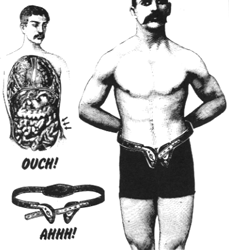
Then there was Phil. For the last dozen of his ninety-six years he'd worn a hernia belt for a gigantic inguinal hernia, because no surgeon would touch him with a ten-foot scalpel. Truss me: no appliance works worth a damn, especially on such a large rupture. He was constantly miserable: trouble walking, trouble keeping clean. Sore, worse when he strained to pass urine or stool. Uncomfortable in any position, he was reduced (no pun) to spending life in a recliner. In short, after suffering his way through and well past his golden years, for some reason he'd finally had it with the thing and decided to try again to find him a surgeon. Unlike Harry's, Phil's heart had been run well beyond its warranty. And yet here he was, practically begging for help, saying the wretched thing had made his life finally not worth living. I don't believe in choosing surgery as a pleasant alternative to blowing your brains out. But I do think it's a rare situation that precludes surgery no matter what, in a person capable of making decisions. Besides which a nicely done local anesthetic with an anesthesiologist sitting by to keep an eye on a couple of monitors is a pretty low-risk way to fix a hernia, even in a frail fellow like Phil.

On his office followup, he and his live-in buddy told me they'd had a truss-burning party a few days earlier.


Much as we'd like it, there's no even slightly precise way to answer the question, "What are my chances, doc?" Studies tell us a breakdown of a thousand patients, but not what will happen to the one sitting in front of you. Nor is there some easy algorithm for calculating risk/benefit. Implicit in recommending surgery is the belief that the danger of the proposed operation is less than the danger of the disease being treated. But that's really just a (hopefully) sophisticated game of odds-playing: since nothing is 100% -- neither the surgical outcome nor the behavior of a pathological process -- the right decision will end up wrong for some people. Moreover, it's obvious that a given medical status -- say, various heart or lung problems (or both!!) -- figure in a different equation if the targeted disease is the occasional gallbladder attack, versus colon cancer. And if someone shows up with a perforated colon causing generalized peritonitis, you're going to have to operate no matter what the pre-existing factors are. You take as much time as is safe to tune the patient up (balancing the ill effects of delay vs. the increased safety of correcting the correctable) but unless there's virtually no hope of getting the person through (and it's rarely possible to be absolutely certain) you'll likely go ahead. Which is why I said above that it's a rare situation in which surgery can be said to be impossible.

Diabetes, obesity, heart failure, chronic lung disease, liver or kidney problems; reduced immunity, taking certain drugs, smoking. All these things increase surgical risk, meaning they add to the chances of peri-operative problems. We can -- assuming there's time -- address them ahead of the operation: get blood sugar well-controlled, optimize heart function, taper off steroids when possible. Stopping smoking before surgery makes a measurable difference. Many plastic surgeons will refuse certain cosmetic procedures in smokers, because of known interference with healing. Even reconstructive surgery is jeopardized: smoking decreases circulation in small vessels, putting fancy flaps at risk. It's easy to tell smokers by they way they cough on the breathing tubes during surgery, and by the crap that needs sucking out of their lungs during and after operations. Stopping for even a week may make some difference; a month or six weeks is way better.

When the risk of not doing surgery is greater than the risk of doing it, we go ahead. Which makes sense. The difference between medicine and some other worlds is that the most precise medical data are by their nature imprecise. How amazing it is to be able to fire off a rocket from Planet Earth and know exactly when and where it will arrive at Mars; to be able to send a signal at exactly the right second to initiate a burn, to send a lander bouncing to the surface within yards of the target a million miles away from the pushed button. Doctors -- because it's true -- point out that no computer, no algorithm can reproducibly predict specific outcomes of diseases and the interventions aimed at them no matter how close we are. Layered upon all the information assembled from past studies, from personal experience is some sort of instinct for doing the right thing at the right time. In the best of all worlds, instinct would count for very little. Who wants to think their doctor is just guessing? We're not there yet, and it seems doubtful we ever will be. Among the aims of medical education and research ought to be always to strive for more precise ways to diagnose and treat disease, more accurately to understand the variations in which an illness behaves among victims and by which it responds to a treatment. To eliminate the need to guess, trust the gut, make a leap of faith. To crank out doctors who vary not at all among themselves in their ability to diagnose and treat, the outcomes of whose care will be as interchangeable as a set of pistons. Ain't, of course, gonna happen. There's more of a chance of narrowing the differences among doctor performance than there is of getting to the point of perfect predictability of pathological process. "Educated" and "guess" will never be separable from one another in medical care. Even as the former increases and the latter decreases, they will remain hand in hand, an imperfect marriage. Don't smoke.

Sampler

Moving this post to the head of the list, I present a recently expanded sampling of what this blog has been about. Occasional rant aside, i...