
It was so unusual that I wanted to write it up and send it to a journal for publication. But I didn't want to embarrass my colleague, who was a good guy. So I tell the story here for the first time.
When something shows up on a mammogram that warrants investigation, but can't be felt, you need to sample it using some form of Xray guidance. (If you can feel it, you can poke a needle into it in about two seconds, taking a sample for analysis. Or do a surgical biopsy. But when you can't feel it, there's no simple way to get at it in the office.) There are two main choices: wire localization, or sterotactic biopsy. In the former, the radiologist guides a wire to the area, and the surgeon then operates, following the wire to the target. In the latter, the radiologist does the whole procedure, with the woman lying prone, breast hanging down into a device which is aimed by Xray and then sends a biopsy-needle to the zone. There are, as usual, pros and cons of either method. Choosing one over the other depends on factors I might get around to some day. More and more, the stereotactic method is used; which is fine. In an ideal world, however, there'd be surgical input into the decision: coordinating diagnostic interventions in breast disease can eliminate a lot of unnecessary or duplicated testing. But I digress...
Marlene had had needle localization for a shadow on her mammogram. "Enormous" would be the word to describe the organ in which the shadow resided. The surgeon who did the procedure -- struggling, I'd imagine, in a very deep hole, following a flimsy wire into oblivion -- unfortunately cut the wire as he was working his way to the far end. As one might expect, gravity being what it is, the wire disappeared into the abyss. The surgeon spent a very long time trying to locate it and the target to which it pointed, and failed. He even transferred her from the surgicenter to the hospital across the street, where he used a mobile Xray machine (called a C-arm, for the shape of the business end which can be positioned to take live-action pictures on an operating table) without success. He gave up. Fully recovered and not a little pissed, Marlene came to see me for a second opinion.
Reviewing the Xrays led me to a couple of conclusions. First, uncomfortably: the shadow in question had, comparing mammograms taken regularly for several years, quite innocent characteristics (maybe fodder for another post, sometime) and -- more importantly -- had been unchanged for at least eight years. I, in other words, wouldn't have recommended biopsy in the first place. Second, the surgeon had given a pretty thorough effort to finding the wire, and I had no reason to think I'd be any more successful. We deliberately leave metal objects of all sorts in people; I didn't think the wire was in need of removal for its own sake. So I recommended watchful waiting, beginning with a repeat mammogram in a few months. If anything, Marlene seemed relieved. She's had enough plowing around in her breast for a while, thanks very much. She might have been a teensy bit annoyed at having undergone what may have been an unnecessary procedure, but we didn't dwell on that aspect. So when she reappeared in my office later, as planned, bearing the repeat Xray, we were both pleased to note that the shadow remained quite benign-appearing and absolutely stable. I was, however, a little puzzled to note that the wire was no longer there.
As usual, there are several types of wires from which to choose. Below is the kind I like:
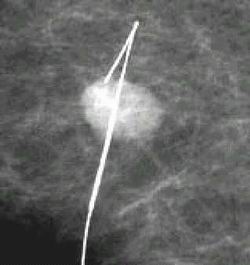
It has a sharp backwards bend at the end, which discourages accidental dislodgment -- as can happen during the hubbub of transferring from the radiology area to the OR (not rarely involving a ride in a car) or during the operation itself. It also -- not relevant to the present tale, but giving credit to the inventor -- has a change in diameter near the end, which is helpful in pointing out that you're nearing the target as you dissect. It hadn't occurred to me until now (why would it have? It had never come up) that the characteristics of the hook could, with motion of the breast, allow for inching it forward. Guessing the wire had migrated itself to the periphery of the breast, outside the mammogram field, I ordered a regular chest Xray, and indeed it showed the wire. But not hardly where I'd expected it. Not hardly at all.
At the far edge of her right lung, is where it was. It had originally been in her left breast! And -- for you anatomists out there -- subsequent views showed it was definitely within the lung, not overlying it on the outside. Now, here's the hard part, because I'm not clever enough to be able to draw explanatory pictures and load them into this blog: the only way this could have happened is if the wire had humped itself directly down through the breast, through the chest wall, and into Marlene's heart: her right ventricle, to be precise, after which it was flushed out into the pulmonary artery and sent into the lung. The only other avenue was for the wire to have entered a vein in Marlene's breast -- or the big vein under her collarbone (the subclavian vein) and then gone to the heart. But the wire was at least two inches long. No way it could have made the twists and turns required of that circuit, starting its journey through a small vein.
"I've got some good news, and some bad news," I told Marlene. "The good news is that the shadow in your breast continues to look harmless, and safe to leave alone. The bad news is that the wire..... DRILLED A HOLE THROUGH YOUR FRIGGIN' HEART, PASSED RIGHT THROUGH IT AND STABBED ITSELF INTO YOUR LUNG. YOU'RE GONNA DIE!!!!!" OK, I didn't say that last part. But I figured that's what she'd hear, no matter what I said. Who wouldn't? I explained as mildly and as carefully as I could, drawing the sort of pictures I'd be doing now if I were clever enough, pointing out that if anything bad might happen, it'd already have occurred. I must have done alright, because Marlene remained seated calmly, as opposed to falling to the floor. I told her honestly that I'd neither seen nor heard of anything like it, and that I'd get consultations from cardiologists and chest surgeons; but that I thought the wire had done all the traveling it would ever do, and had come peacefully to rest where it would do no further harm. She liked that.
Catheter-wielding cardiologists and scalpel-wielding heart surgeons agreed: leave the damn thing alone. More damage was possible from trying to get it out than it could conceivably cause left in place. Subsequent Xrays over the next year confirmed it was happy where it was, and so was she. I'm pleased to say I'd never cut and lost a wire in a breast; but after meeting Marlene, I was even more careful with them than I'd been.


